The Trash of Which I Do Not Speak (or Photograph)

20160316_114921.jpg
Happy Birthday, Girl!

Yesterday, my labrador retriever turned 13 years old.  She’s lumpy and bumpy, the ACL she had repaired years ago is clearly aching with arthritis, and she’s deaf and even a little smelling-impaired, but she still wags her tail when she sees her leash, insists on car rides to the woods, and pulls me like a dogsled when she sees a body of water.  She and my other dog, a nervous 4-year-old rescue of unknown lineage, accompany me on most of my walks along the Monocacy.  I take bags specifically for their messes, which I pick up and, despite the smell, carry with me for miles until I reach my trash can at home. It can get a little disgusting some days, but it’s worth it not to leave their piles to filthy the river or someone’s shoes, or even just mar the view.  Besides, I’ve decided that if anyone is idiotic enough to attack me, I could swing the bags in their face and they’d likely decide I wasn’t worth their trouble.

While I am happy to pick up my own dogs’ messes, I’ve decided that I absolutely will not pick up the messes of anyone else’s.  I know that I should, and feel guilty when I pass by the melting piles of it, but I just won’t. So, you won’t hear about this particular kind of waste, or see a picture of it, in or out of a bag, in this blog.  It exists, of course; I’m just pretending it doesn’t so that I don’t activate my gag reflex on a daily basis.

There are those who will argue that there shouldn’t be any dogs on nature trails. The untended messes are part of these protesters’ arguments, but they also object to the dogs’ invisible marking, which scares off other wildlife. Dog-lovers, on the other hand, argue that their companions compel people who might otherwise just sit on their couch binge-watching TV shows to go out into nature and, as they learn to appreciate it, decide to take action to protect it. As a traditional peacekeeping middle child, I say let’s have it both ways, maintaining natural areas where dogs are not allowed and other areas where they are encouraged by making available waste bags and plenty of trash cans to their responsible owners.

Anyway, I hate preaching. And I hate picking up poop. And I’m not talking about any of this ever again.
Let’s Pretend

20160316_101443.jpg

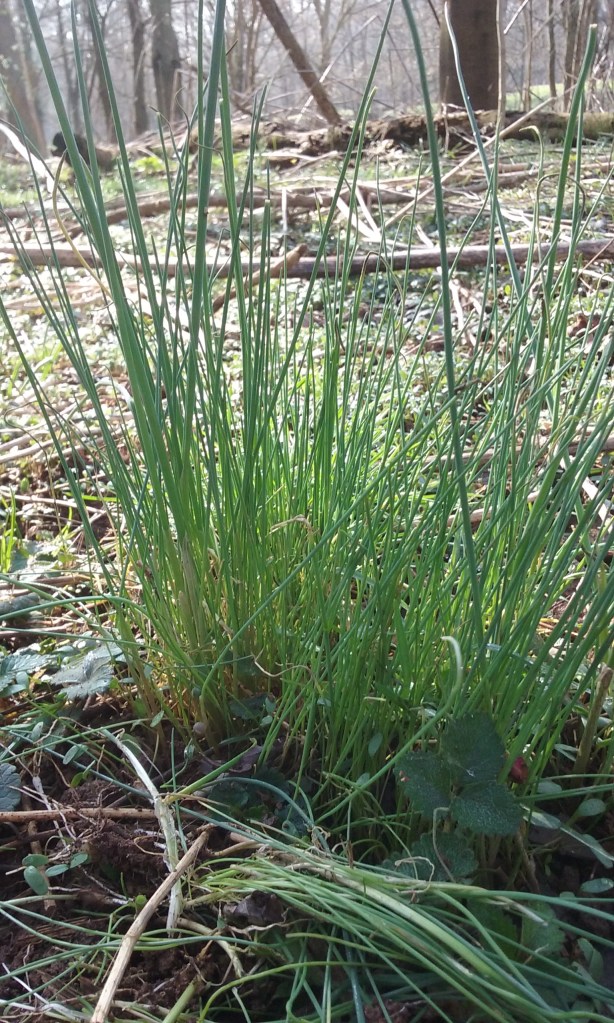
Along with wildflowers, early spring brings wild onions, which will continue to flourish through most of the summer. Whenever I see them, I remember an elaborate game my brothers and sisters and I used to play in our backyard. It was called “Shipwreck,” and, more than a game, it was a melodramatic improvisation in which we had to pretend that we’d been stranded on a desert island and needed to find a way to survive. It worked best on sunny summer days, when heat and thirst made method actors of us.

The game was simple. After “crashing” our airplane built of picnic benches and and rusty backyard furniture, we  tumbled onto our lawn, usually into the large patch of dirt we used as home base in our other games. My oldest sister was the organized one, who roused us into realizing our pathetic fate. She ordered us to find shelter, almost inevitably the tunnel formed by the spirea along the fence, and a place to sleep, generally the furniture cushions, which, after baking in the sun, had a warm, comforting mildewy smell. For food, we foraged in our battered lawn, where we could always find some mature wild onions. My sister would collect them and hang them from the bars of our swing set, as if drying them might make them more edible. The game could go on like this infinitely, because, as I recall, we never actually got saved. We just stopped playing.

Thankfully, my sister never actually made us eat the onions.  My younger son, on the other hand, used to eat them all of the time, when his older brother told him that he was Felicia the horse and that wild onions were his proper food. He also ate a lot of grass.  While he doesn’t do this anymore, he still eats a profane amount of vegetables.  We’re making our garden bigger this year.

20160316_101620.jpg

In addition to the onions, I found some lovely marsh-marigolds (caltha palustris), growing by the same temporary pond where I heard the spring peepers a few days ago.  The fresh green leaves and delicate yellow flowers are striking against the dark of the marsh.  Especially now that the shredded red plastic cup is gone.


Still Life in Plastic Bottles

In the 6th grade, in response to my art teacher’s assignment, I drew a series of Sunkist cans in pencil.  I still have these sketches somewhere, probably in a bin of memorabilia in my basement, along with my accumulation of diaries, letters and photo albums.  Today, as I flipped bottle after bottle into my bag, I recalled those Sunkist drawings, and wondered whether I should add to them.  I’ve already got a great retro title: “Soft Drink Still Life: Still Awesome After 30 Years.” There would need to be a little updating, of course, like replacing the Sunkist can with a Vitamin Water bottle.  I got two of those today, in addition to the regular water bottles (mostly store-brand, but there was a large Evian one, too, because litter is a phenomenon that knows no socioeconomic boundaries).  Just in case inspiration strikes, I took a picture of them all before dropping them in the recycling bin.

UPDATE 10/28/16: I found the 6th grade drawings! And then promptly recycled them. This hobby of mine has encouraged me not to accumulate so much…stuff. I did photograph them for posterity, though:

Boats for Mice

It’s been warm and clear the past 2 days, which has allowed the recent floodwaters to recede and the debris left behind to dry in the sun.  As this happens, lots of bundles – leaves, grass and, often, trash, tightly bound by dried mud – appear on the tips of tree branches, like mittens. One boy I know likes to slide the bundles off and let them go down the river.  He imagines them as tiny boats for even tinier mice.