The Thing with Feathers

20160123_110241.jpg
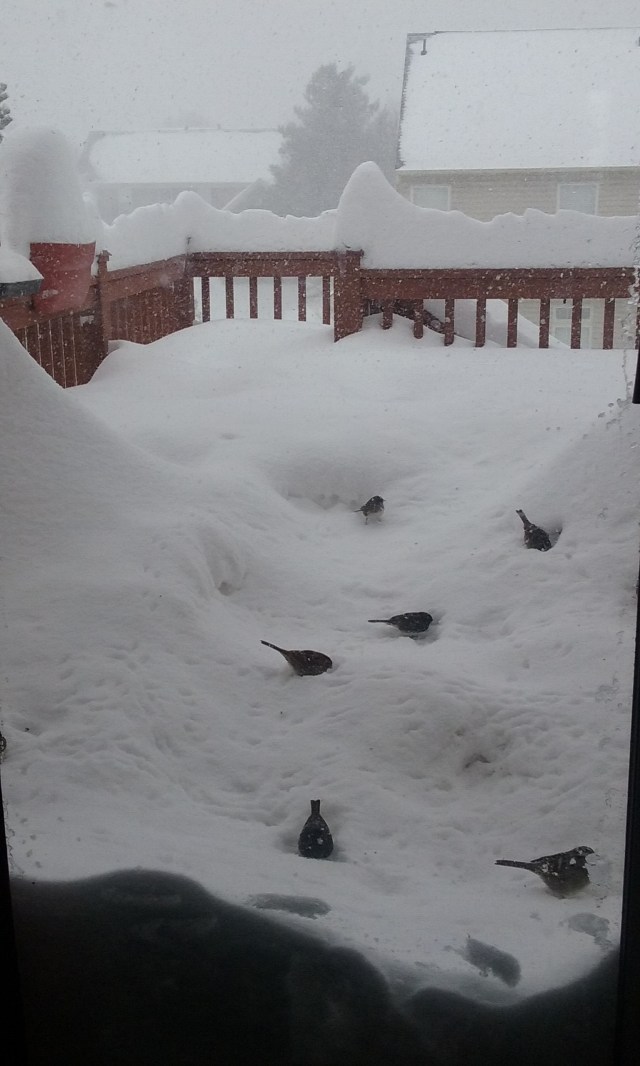
Juncos and friends braving the blizzard of 2016

When I was a little girl and people asked what animal I would like to be, which, for some reason, they did quite often, I would always answer, “A swan.” Likely I was influenced by fairy tale drawings (what was a castle, after all, without a swan swimming in its lake, preferably at sunset?) and at least a little by E.B. White’s The Trumpet of the Swan and Hans Christian Andersen’s The Ugly Duckling. The swan, to me, was the epitome of beauty and elegance, with a potential for a brilliant future, and, of course, it could swim or fly with equal grace.

When I grew a little older, I began to find the swan and bit too ostentatious, and, by the time I was a teenager, desiring total anonymity and feeling very small and frightened, I decided that I would rather be a mouse. Sometime in my thirties, although people had stopped asking, I decided again that I would like to be a bird, but not a swan. Instead, I would like to be a small bird, a common bird, one that is much stronger and and more interesting than people assume.  Maybe a chickadee, like those I watched endure Minnesota winters with cheerful fortitude, fluffed up among pine branches in their small black caps, or a junco, like a little gentleman in a gray tuxedo, so dapper and sprightly, even in the midst of a blizzard. I’m not sure, but I do admire them. And I wish that I could fly.

Because of my affinity for birds, I watch for them, and observe them, and, on a separate page on this blog, record them.  Today was a particularly good day for spotting birds at the Monocacy.  Besides the usual Robins, Red-wings, and Cardinals, I saw an American Goldfinch, an Eastern Bluebird, a few Tree Swallows, a pair of Canada Geese (accompanied, for some reason, by a bachelor Mallard), a Red-tailed Hawk, some noisy Crows, and a wading bird and woodpecker that were just too far away for sure identification.  Honestly, I was so distracted that I left quite a bit of trash on the ground. But, unlike the birds, it’s not going anywhere, and neither am I.  For now.
The Monocacy Rocks

20160403_164707.jpg

I should be writing about the fairyland that the wild blooming bluebells have made of “the island,” but it’s just too cold.  Instead, let’s talk about geology.

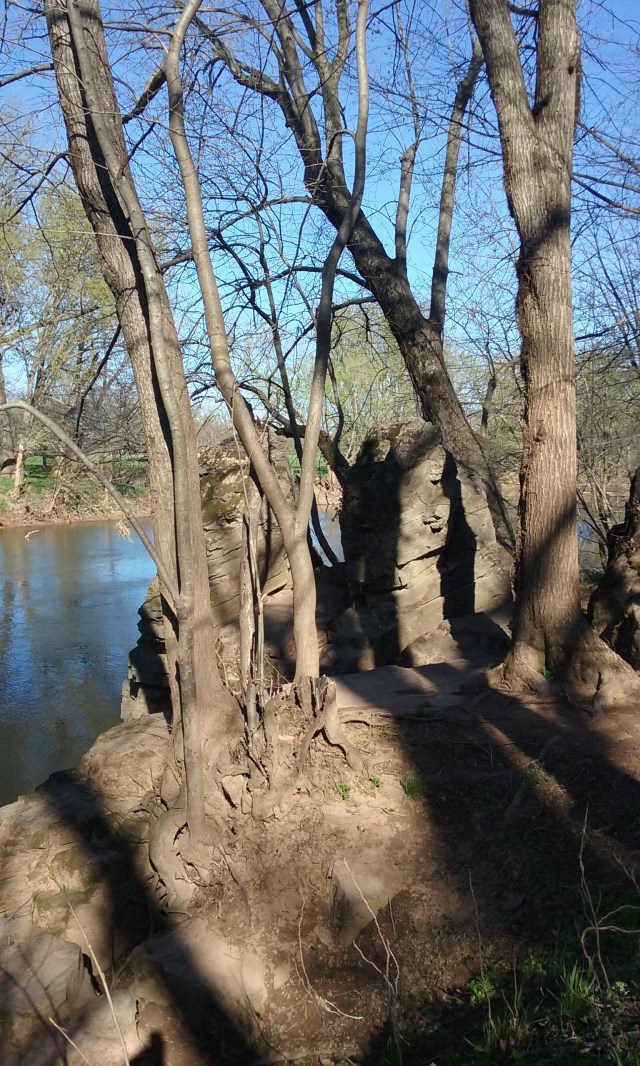
Referring to my copy of Roadside Geology of Maryland, Delaware, and Washington, D.C. by John Means (Mountain Press Publishing Company, 2010), I can tell you that the Monocacy River, which drains most of the Frederick Valley, is situated on Cambrian Frederick Limestone as it flows through the city and its immediate environs. As I walk with my sons along the river’s shores, sometimes under tall embankments created by years of flooding, we pick up lots of quartz and limestone.  My oldest son has become skilled at skipping the flatter pieces, even managing to eke out  5-7 jumps from large 5-pounders. Over the weekend we veered off our usual path and stopped at some very striking limestone formations that jutted out about 15 feet over the water.  While my son found huge rocks to roll into the river – the splash was marvelous from such a drop – I found a McDonald’s cup.  I hope it was iced tea that I dumped out of it.

Just put the trash down and…

20160404_094342.jpg

It’s been a bit cold lately, but, despite historic winds, also vividly clear and sunny.  When I went for a walk this morning it was in the 40’s, which didn’t stop any of the wildlife from going about their spring business.  In a marsh a pair of Canada geese were blaring their horns at each other, barely succeeding in drowning out the insistent territorial buzzes of the red-wing blackbirds; a groundhog cautiously popped his head out of a hole on an embankment; an audacious mockingbird cycled repeatedly through his vast songbook from the top of a sycamore tree; and more than one cottontail noisily fled from me through the underbrush.  There was, however, at least one creature hiding from the unseasonable temperatures.  Beneath a a scrap of thick, back plastic, I found a wee beastie coiled up in a loose spiral: a baby garter snake too cold even to be bothered by me.  After taking a picture (which required that I bend down only inches away from him), I recovered the poor cold-blooded baby with the plastic.  Because today it was more humane not to pick up the trash.

Let’s Pretend

20160316_101443.jpg

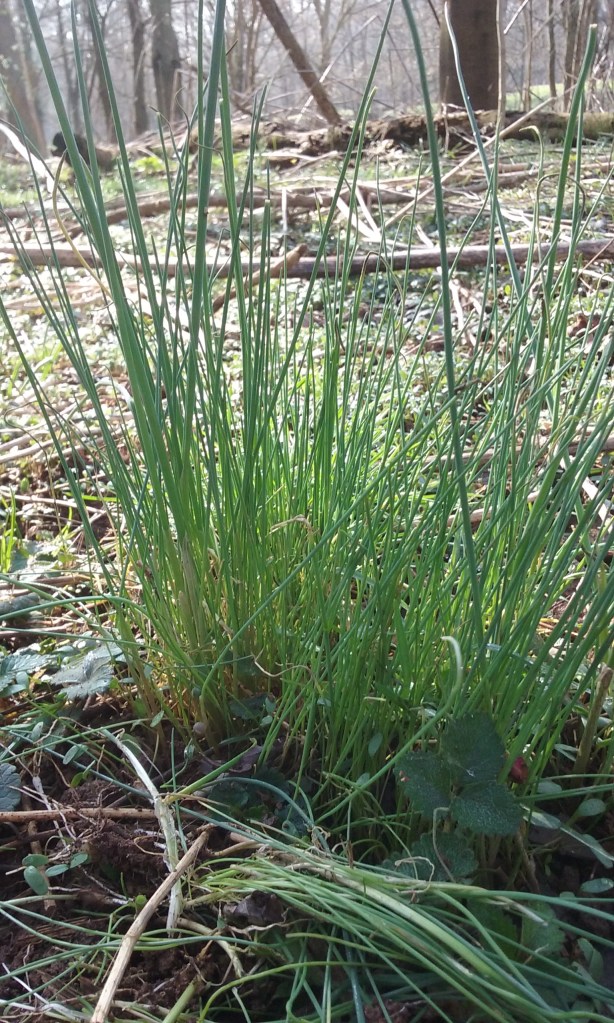
Along with wildflowers, early spring brings wild onions, which will continue to flourish through most of the summer. Whenever I see them, I remember an elaborate game my brothers and sisters and I used to play in our backyard. It was called “Shipwreck,” and, more than a game, it was a melodramatic improvisation in which we had to pretend that we’d been stranded on a desert island and needed to find a way to survive. It worked best on sunny summer days, when heat and thirst made method actors of us.

The game was simple. After “crashing” our airplane built of picnic benches and and rusty backyard furniture, we  tumbled onto our lawn, usually into the large patch of dirt we used as home base in our other games. My oldest sister was the organized one, who roused us into realizing our pathetic fate. She ordered us to find shelter, almost inevitably the tunnel formed by the spirea along the fence, and a place to sleep, generally the furniture cushions, which, after baking in the sun, had a warm, comforting mildewy smell. For food, we foraged in our battered lawn, where we could always find some mature wild onions. My sister would collect them and hang them from the bars of our swing set, as if drying them might make them more edible. The game could go on like this infinitely, because, as I recall, we never actually got saved. We just stopped playing.

Thankfully, my sister never actually made us eat the onions.  My younger son, on the other hand, used to eat them all of the time, when his older brother told him that he was Felicia the horse and that wild onions were his proper food. He also ate a lot of grass.  While he doesn’t do this anymore, he still eats a profane amount of vegetables.  We’re making our garden bigger this year.

20160316_101620.jpg

In addition to the onions, I found some lovely marsh-marigolds (caltha palustris), growing by the same temporary pond where I heard the spring peepers a few days ago.  The fresh green leaves and delicate yellow flowers are striking against the dark of the marsh.  Especially now that the shredded red plastic cup is gone.


Weeds are Wildflowers

So, if you don’t treat your lawn, your neighbors will give you the stink-eye, but you’ll also have some lovely wildflowers.  The first of the season are blooming now, while grass is the dingy green of late winter.  Above, on the left, we have Bittercress (cardamine, either Pennsylvania, which is native, or Hairy, which is invasive) and, on the right, Persian Speedwell (veronica persica). You can find a a few paragraphs about these early wildflowers in Bryan MacKay’s A Year Across Maryland: A Week-by-Week Guide to Discovering Nature in the Chesapeake Region (The Johns Hopkins University Press, 2013, pp. 62-63), which is a wonderful book for anyone who likes to tramp around the Old Line State.  While he doesn’t specifically address the Monocacy River, he often discusses the Potomac, which the Monocacy feeds.

Hidden Pictures

For convenience’s sake, I use a smartphone to take my pictures, which means that their quality is not very good, and, since my phone is the most basic model, I have no ability whatsoever to take a close-up unless I can get within a few feet of my subject.  This makes nature photography pretty much impossible, particularly if my subject is a skittish deer or a bird perched at the very top of a tree.  Nonetheless, I do try to capture an image every now and then, when I just can’t help myself, like today, when I heard the spring peepers for the very first time.  They’re here somewhere, very loudly trying to find this spring’s hook-up:

20160311_093442

Another loudmouth this time of year is the Red-winged Blackbird, which lords over the same wetland habitat along the Monocacy’s floodplain. I like listening to the Red-wings’ song, ranging from a harsh buzz to a liquidly trill, when they arrive in early March.  When I was a girl, I confused them with Orioles because of their flash of orange. Can you see the one singing at the top of the tree?

20160311_093052

Yeah, I didn’t think so.

Although springtime distracted me today, I did manage to collect a few plastic bottles.  I’ve considered inventorying these by brand or type of drink (water, soda, juice), but, unless someone makes a special request, I’ve decided that this would be rather pointless.  So, for now, I just recycle them.


The Great Blue Heron

20160208_165705

The Great Blue Heron is among the most regular of the birds I see along the Monocacy.  Regular, but not common.  The birds are tall, elegant and brilliantly marked and feathered.   Their size still takes me by surprise, especially when I’ve startled them into flight and they  appear suddenly beside me, strikingly prehistoric looking.  In them, I can see the relationship between birds and dinosaurs.  Just look at these heron footprints I found a few days ago, and for comparison’s sake, imagine your handprints in the mud alongside them.  Those footprints are bigger.

20160208_165506

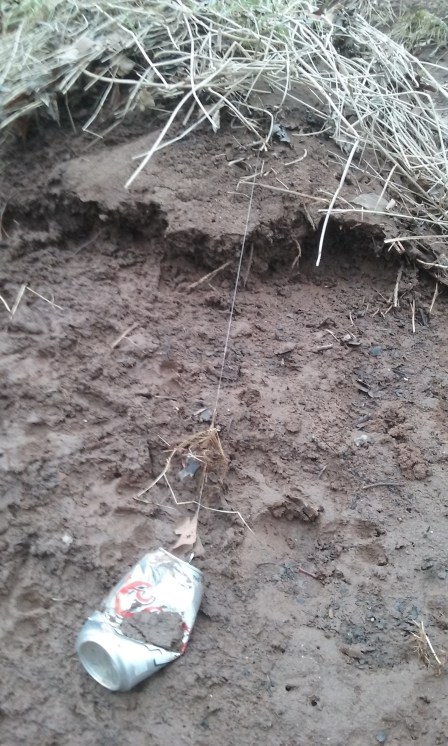
Unfortunately, I’ve encountered one of these fabulous birds caught in fishing line that had gotten tangled in a tree.  It was, understandably, upset and not a little intimidating.  But, fortunately for the bird (and, for me, who would’ve been plagued by guilt), a daring man decided to stop, hazard his own skin, and cut it free. Fishing line (as seen in the photo above, attached to the interior of a beer can) is another thing that I find quite regularly along the Monocacy.  During the summer, the river is a popular destination for fishermen (and women, not that I’ve had any luck, which is another story) to dip their rods in the murky water.  Often they leave behind the styrofoam cups that held their bait and the cans, bottles and wrappers from their picnic lunches. Those bits of trash are annoying, but the fishing line is dangerous.

The good news is that it’s a piece of trash I don’t have to pick up and take home with me.  The city of Frederick has set up little stations to recycle the line at most locations where fishing is a usual pastime. That includes parks along the Monocacy, including Riverside Park under the Monocacy Avenue Bridge, which is the most accessible in the city.