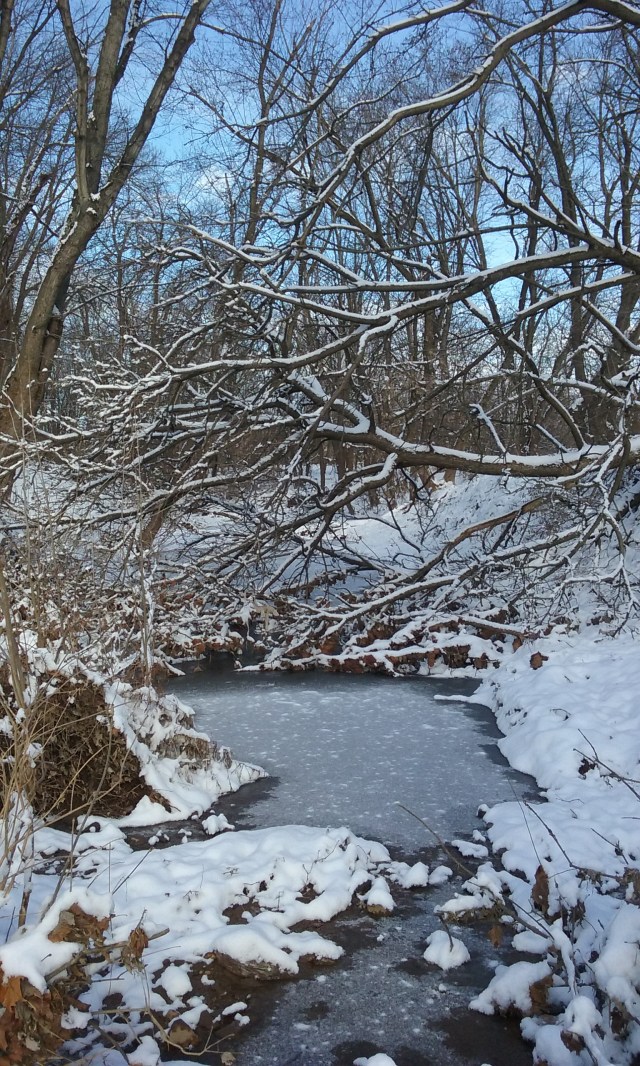
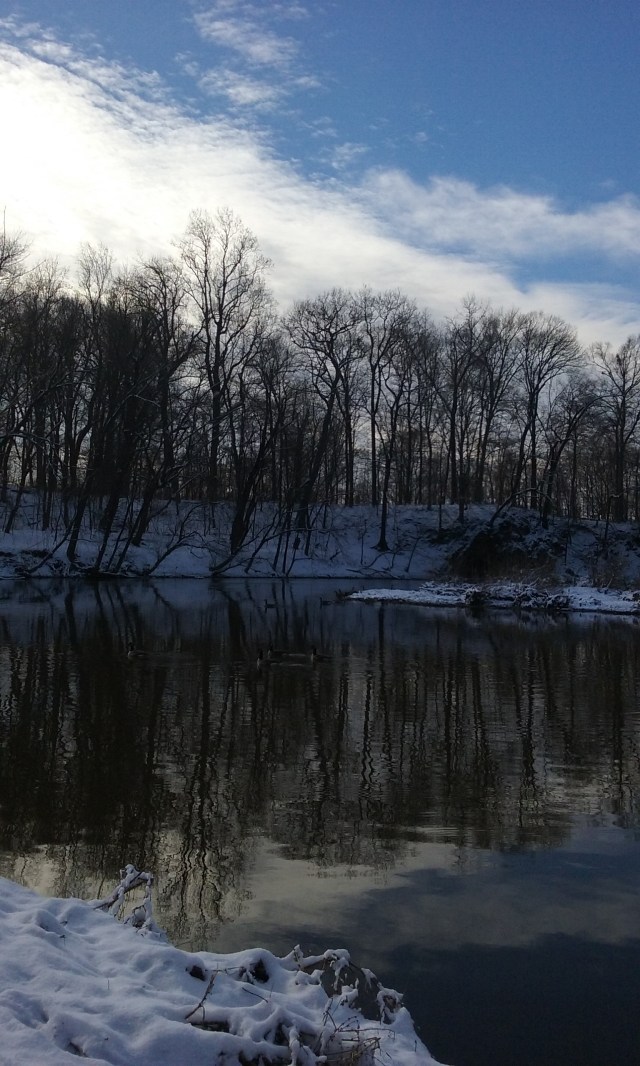
On my walk to the river this morning, I stepped off of the main path in order to avoid meeting anyone; it was an altogether unnecessary move. Yesterday eight inches of wet, heavy snow fell, which closed the schools and brought all sorts of revelers and shovelers outdoors, but last night the temperatures plunged and winds whipped up, which is always enough to drive people back indoors in this part of the world. As I walked, my boots barely broke through the surface of the snow, which had frozen overnight, and the only other tracks I encountered were those of the deer who had bounded off a few minutes before.
The sun was a weak light through flurry-bearing clouds, more of January than March. A week ago, I was taking pictures of Virginia spring-beauties, celandine, and bluebells, but today the most notable flora was wind-blown grass lying flattened across a dune of snow.
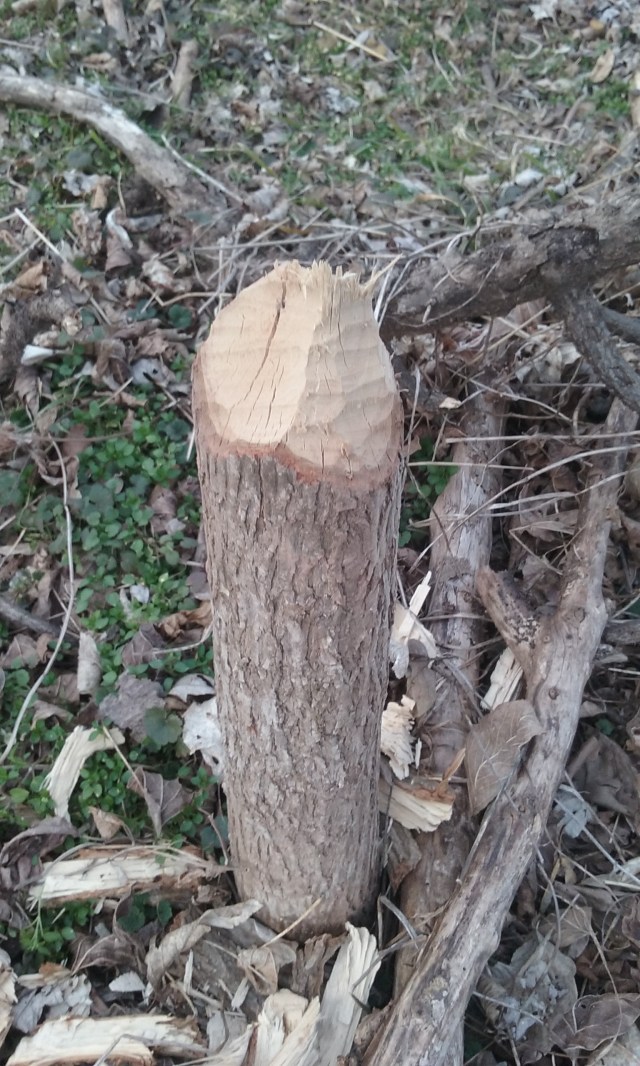
A couple of weeks ago, I diverged from my regular rounds along the Monocacy and came upon a young tree trunk that looked as if it had been hewn by a wood-carver.
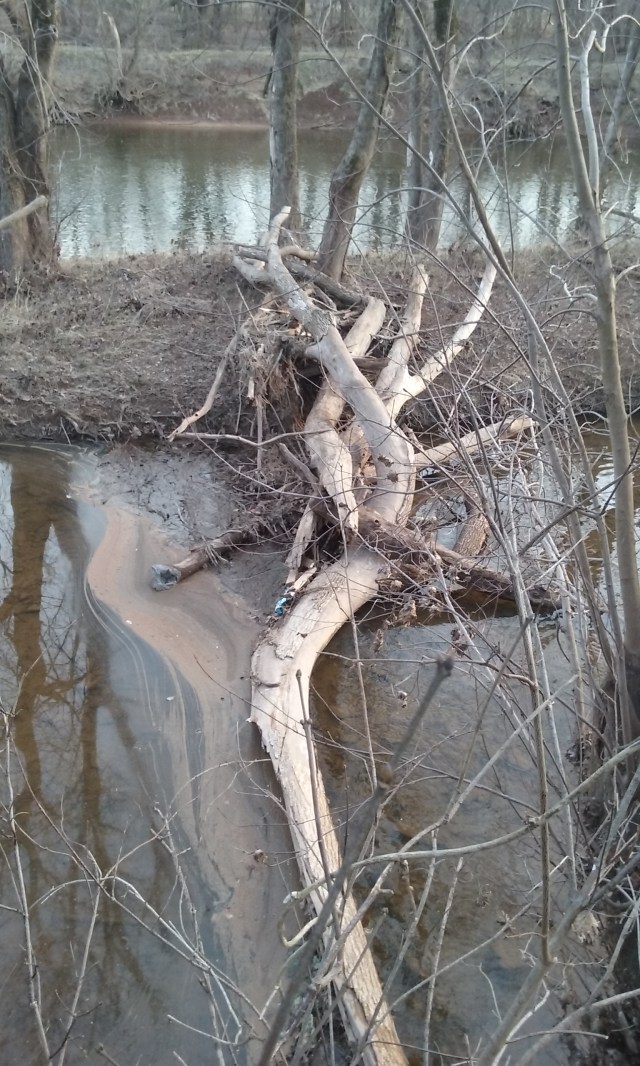
I took note and walked a little farther along to find another tree that had been similarly cut. Now strongly suspicious, I stepped a little closer to the steep riverbank, scanned the waters, and found what I expected: a dam.
Such logjams are not uncommon. They occur naturally after flood waters push down and collect fallen trees, branches, leaves and other debris (i.e. trash) against obstructions in the river, such as boulders, bridges, or small islands. I had a feeling that in this case I was seeing the work of another river dweller, one of earth’s largest rodents, the North American Beaver (Castor canadensis). Just to be sure, I revisited the area yesterday and found that even more trees had been felled.
While I would very much like to meet the beavers, I’ve a feeling that they’d prefer to avoid me (I live in Maryland, after all, not Narnia), so I had to make due with knowing that they were nearby and looking about their home. Unfortunately, the light was horrible, flat and almost numbing, so I had to play a little with the paltry light meter on my phone when I tried to photograph these industrious beavers’ environment. None of the results are accurate.
Besides frustrating myself with my limited camera, I managed to gather an overflowing bagful of trash, some of it unusual (the foam from a bike seat!). I don’t usually get noticed, but today a man observed me and remarked that I had an impossible job. “Just a little bit every day,” I answered. He just kept walking.
There is a special time in early spring (or late winter, as it so happens) when this year’s young sprouts meet last year’s faded ghosts. The dry, burst seed pods of dogbane and the gray-headed husks of brittle goldenrod intermingle with the round, new buds of a dogwood. The delicate leaves and blue blossoms of bird’s eye speedwell break through a thick, crusty layer of leaves that last year crowned the branches of nearby hickories, oaks, and maples. Yesterday: meet today. Or is it the other way around? To me, it is a reminder that time is not a straight line, that there are few clean endings or beginnings, and that what is behind us is never really left behind.
The warmer weather that has been hounding us most of the winter surpassed itself over the long weekend, bursting into a series of summery days that resulted in a) lots of human activity and b) lots of human trash. My elbows are still recovering from the weight of the garbage bags that I had to carry home, and I have far more recyclables than my 2 bins and bi-weekly collection schedule can manage. While I usually take a sort of housekeeperly pleasure in cleaning around the river, weekends like these are overwhelming. It’s frustrating to have to leave things behind (such as a stash of cans squirrelled beneath a log) simply because I don’t have enough bags to hold it. That’s when I remember that this is a job that is never finished. Like laundry. (Actually, I found some of that, too).
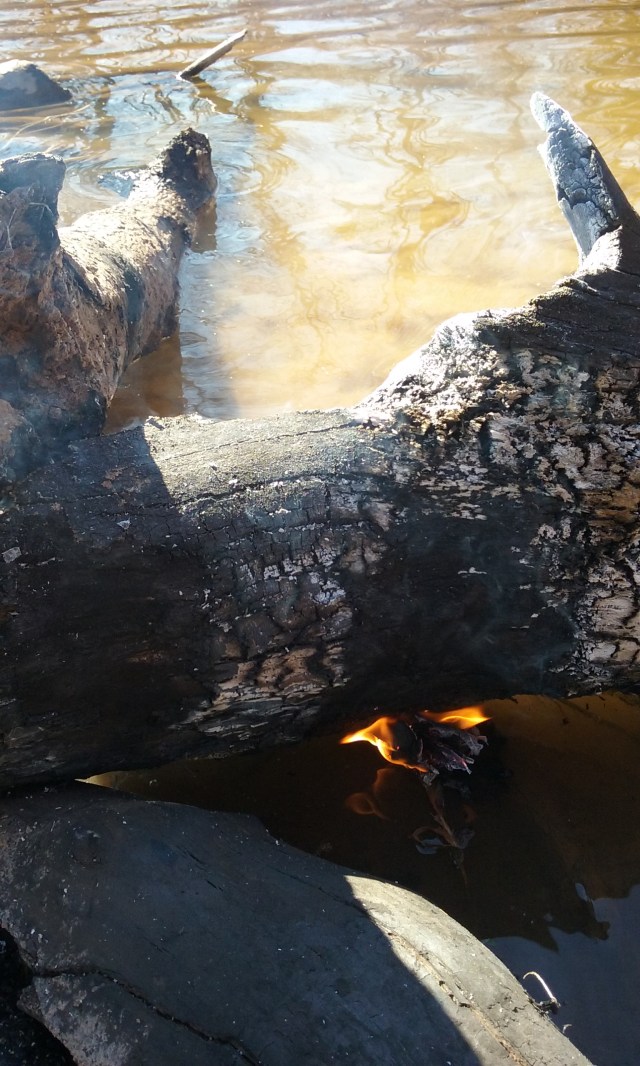
Two days of collecting were particularly intensive. On the first of these, the boys and I encountered a fire circle with one log still so smoking hot that it took little more than a dry leaf to reset it aflame.
After we hauled the log farther into the water, I set about gathering a case’s worth of beer cans, a six-pack of bottles, and other such picnicky miscellany. I couldn’t help but see the irony in having to clean up yet more Budweiser “America” beer cans, which have splashed across them the lyrics of “This Land Is Your Land,” by Woody Guthrie, a song that highlights the natural beauties of the United States. (For the song’s history, see the concise NPR story http://www.npr.org/2000/07/03/1076186/this-land-is-your-land). Yes, indeed, this land is for you and me. I wish that we could all remember that. And behave that way.
On the second day, I found an entire campsite’s worth of garbage. Literally. A tent had fallen down an eroded bank into the water below, along with a slew of cans and food wrappers, mostly submerged in mud and impossible to extricate. As I filled up all three of the bags I had brought and two more bags that I found, I was grateful for the broken, soft-sided cooler, which served as an excellent trash receptacle after I dumped the muck that had accumulated inside of it. To reach the makeshift site, I had to ford the river twice, which, since my five-foot frame was so weighed down, required that I carry everything back in shifts.
All of this activity managed to startle a fox, who zipped past me in all of his sly regalness. He wasn’t twenty feet away, but my hands were too full to grab my camera. Perhaps it was the campsite that had attracted him in the first place. It’s hard to tell. But he didn’t appear drunk, and there was very little but alcohol left to consume. I, unfortunately, stank with beer that dribbled from the cans as I collected them, and I’m pretty sure that the odor, combined with my bag-lady appearance, is what earned me a few nervous stares from families with small children on my way home.
Last week’s rains filled the Monocacy to its banks, which prevented exploration for a few days, but as the water receded to more average levels, we were treated to another sort of fun: mud. Lots and lots of it. The kind that sucks off your boots and ends up in your hair. While the boys modeled it into facades that seemed to lead into the riverbanks (and which reminded us of something out of Tolkien, like the Mines of Moria, but for muskrats), I discovered a veritable treasure-trove of tracks and footprints.
They reveal the life along the river that I rarely see; the creatures that come out when I’m not there. Honestly, evidence of the white-tailed deer is everywhere, in the form of scat that my younger dog takes too much pleasure in rolling herself in (and then pouts for days over the subsequent bath), and the squirrels are rarely too shy to show themselves, either. Raccoons, however, are more secretive (being nocturnal), and herons, although visible, prefer not to let me get too close. The Monocacy is host to other animals as well: opossums (one of which made it into my house), shrews, moles, voles, mice, chipmunks, groundhogs (whose holes are another obsession for my younger dog), weasels, minks, and otters, just to name a few mammals. We’re there, too, of course, sometimes leaving a little more than footprints
At least yesterday I found a piece of trash that I could use to collect the other pieces of trash. That’s always helpful. If you look on the bright side.
Traffic on the Monocacy Blvd Bridge over Riverside Park.
When I’m in the woods or on the banks of the Monocacy, it’s easy to find tranquil places and to take beautiful pictures. When I take a step back, however, the perspective necessarily changes. The fact that it is an urban river becomes clear and beauty more difficult to capture. Lately my boys and I have been spending a lot of time at Riverside Park in the city of Frederick, which is a short walk from our home. It has a boat launch (for kayaks and canoes, mostly), a soccer field and is the starting point for most of the paved trails along the river, but truly it would be difficult to find a less park-like setting.
While the Monocacy does run through the park, it is hemmed in on one side by a large parking lot and on the other by an expanse of road and warehouses. There is also a clear view of the Monocacy Boulevard bridge, which is always busy with traffic making its way to the shopping malls and housing developments along Rte. 26 (also known as Libertytown Rd.). One of the larger stores is a Walmart, which is due to close within the next week because a much larger one has been built just across the street. As yet, there is nothing scheduled to move into the soon-to-be-vacant building.
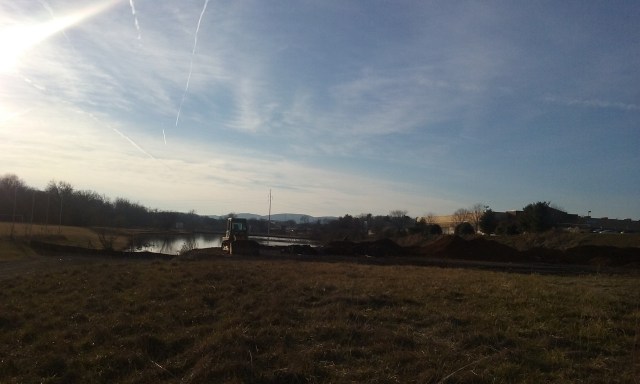
L to R: Trees along the Monocacy, soccer field, flood retention pond, Walmart. The Blue Ridge mountains are in the background and construction refuse area in the foreground.
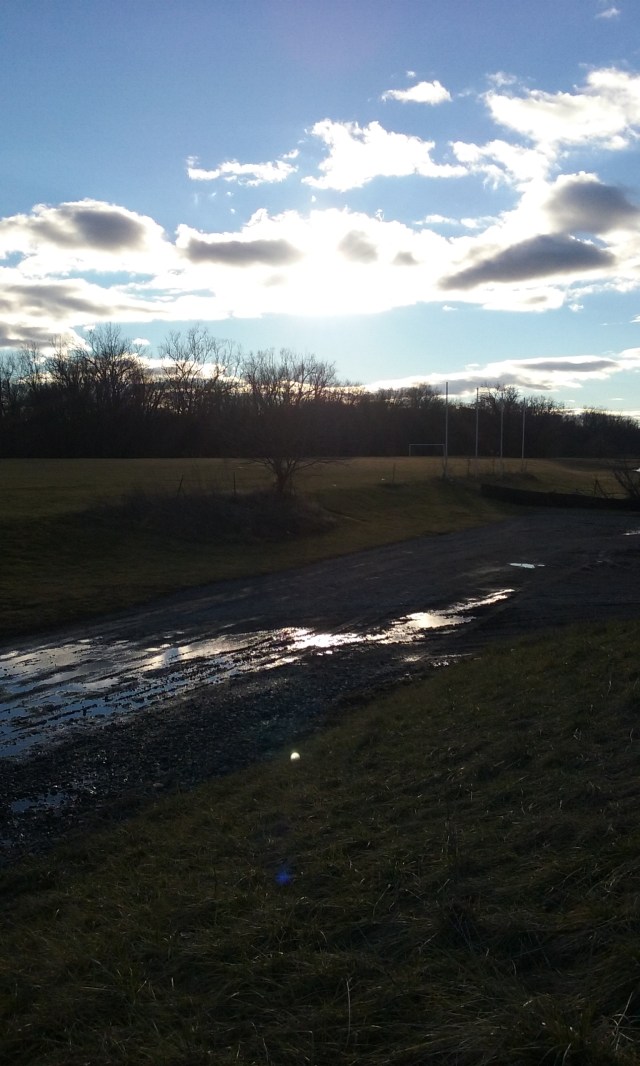
The (now) older Walmart is divided from the park’s playing fields by a man-made pond, which receives the runoff from the store’s parking lot. This helps to keep the river clean, of course, except for those times when the river floods and the fields, parking lot, and retention pond become one massive body of water. Usually, though, this body of water sits on its own, host to Canada geese and the occasional heron. What is more remarkable about the “pond” than the geese, however, is the massive quantity of construction materials that is piled alongside it. From the park’s parking lot, a gated gravel road leads to a flattened space where trucks and earth-movers regularly dump dirt, old asphalt, chunks of concrete, twisted rebar, and other such miscellany. Much to my chagrin, my boys like to climb on these piles, and I spend much more time than I’d like hanging about in what is, at best, a very big dirtpile, or, at worst, a dump. When I’m not gathering trash of the plastic sort, I look toward the mountains and try to wish away the warehouses, cell towers and machines obscuring my view.
The gravel road to the retention pond, with the soccer field and trees along the Monocacy in the background.
But to wish everything away would be to wish myself away. I live in one of the developments on Rte. 26. I drive over the Monocacy Blvd. bridge. I buy groceries in a shopping mall. Frederick was settled early in this country’s history, and the Monocacy has been supporting it since its founding. The people and the river are inextricably linked. We rely on it not only for our drinking water (yes, it’s true!) but for fishing, farming and recreation. Not only should we take care of it, we must. And there can be beauty in that responsibility.
Sorting through my photographs, I realized that there are several that I set aside for a particular post but then, for whatever reason, never used. Although it conflicts with my need for some sort of focus for all of my writing, in an effort not to completely lose sight of my intentions for these pictures, I’ve decided to set them all out today, with notes, like a disorganized scrapbook page. (I have tried scrapbooking before, and it just isn’t in me; neither is keeping an immaculate house. Truly I am a failure as a homemaker.) But, of course, having written this paragraph, I’ve assigned a theme. Why do I do that?
These photographs were to be about line, texture, and symmetry. The old wasp’s nest also reminded me of the huge hornet’s nest that hung inside the ‘Walking Stick’ shrub in my backyard when I was little. I ran right into it during a game of SPUD and suffered the consequences. I never developed a fear of stinging insects, though, perhaps in part because my father took the nest down that winter and allowed my brothers to hang it in their bedroom from the central light fixture. Also, I’m clearly not allergic to them.
I found this and spent the rest of the day with R.E.M. songs streaming through my brain.
Peek-a-boo trash: before and after. I nearly missed this Starbucks cup when the only thing visible was the green straw.
And, of course, I’m still running into the problem, months later, with other sorts of trash. (Yes, Bud Light, again).
My mixed-breed, young Rosie, is obsessed with sticking her head in holes. (Mostly made by groundhogs, I think). I’m a little afraid that one day she’ll pop back up with a bite on her nose. My friend’s dog once got bit by a squirrel, and the poor thing bled profusely. The dog was fine, but the car never really recovered from the trip to the vet.
Okay, so now I’m fighting the urge to write a summary paragraph. Mission almost accomplished.
I like snow. While our first fall of the year didn’t amount to much, I made the most of it. My old labrador’s response pretty much sums up my initial excitement:
A little later in the day, after rounding up my fellow explorers, I found a flock of Canada Geese loitering on the river. Usually we see them flying overhead in formation, raucously honking, bringing in the cool blue haze of a winter dusk, but last Friday afternoon they were merely drifting, skirting the light ice along the river’s edge. Eventually a small flotilla ventured over as if to investigate us, which made me wonder whether they were used to living in ponds where people fed them, but when I approached they backed off. (Which is just as well, considering I had one dog on leash who just loves water birds).
The snow ushered in the stiff, still cold of mid-winter that settles onto me an almost inexplicable peace.As I walk, I smile at the flock of black vultures hunched in a gnarled, bare tree. I quietly watch a herd of six white-tailed deer cross the trail in front of me, leaving behind them a mess of hoof-prints in the snow. I wait for the red-tailed hawk standing sentry over the floodplain to soar from its post. It can be tempting to run from the cold, dashing from car to front door, but it’s so rewarding to hunker down and live in it for a moment.
While the winter solstice is a few days away, its spirit arrived last week, when temperatures plummeted and sleet and ice covered the ground in a white and crunchy coating. The winding tendrils of summer’s itchy hop plants have withered and drawn back from the encroaching freeze, revealing bottles, cans, and wrappers formerly hidden by the tenacious invasive’s spreading leaves. As my boys set shards of ice and small stones skidding across the Monocacy’s ice, I gather the debris, not only for the satisfaction of cleaning, but also to keep myself warm. This time of year, I always wonder at the small animals who do without hats and gloves and fleece-lined boots, like the little nuthatches, sparrows, house finches and wrens that play in the brush, or the small group of bluebirds I spotted in the trees. It makes me feel almost ashamed of my eagerness to return home to heat, light, and a big mug of tea.
As yesterday’s rain clouds pushed away, a fog crept in, dampening dusk’s last glimpse of light. We stuck to the path and made our way to Riverside Park, where the Monocacy Boulevard bridge offers some shelter. When we ventured down the boat ramp, we found that the rising waters and runoff had swept along some garbage as well.
As I wasn’t wearing my waders, I was confounded in my trash collection. On my return home, however, after I picked up a discarded latex glove, a man who was posting small flags on the floodplain by the bridge emerged from the fog to comment on my work and ask whether I would like to do more for the river. Since I was feeling curious, I asked what he meant, and he revealed that he was from Stream-Link Education (how uncanny! I just wrote about them in Connections and Clean-Up) and that the group will be gathering volunteers at Riverside Park to plant 300 trees this Saturday, December 3rd, from 9-11 a.m.
This isn’t the sort of message you expect to emerge from the fog at sunset, but I’m a little more practical than a gothic heroine anyway.












 TRASH ON THE MONOCACY