Fairyland, Maryland


At this time of year, the silver 2-week period when the Virginia Bluebells bloom in concert with the delicate Spring Beauties, Trout Lilies, and even the alien Lesser Celandines, I can’t help but feel that I’m in Fairyland. And today, when the white sunlight shone beneath the gray rainclouds, it lit the world in crisp, clean, and almost metallic shadow, and I felt as if I was walking through a photograph.  With one effect on top of another, I might have been unreal myself, and, as must always be true when a proper fairy has you in its sphere, I was a little unnerved.

A few years ago, my father showed me an old drawing of mine that he had found in his basement.  Surrounding a smiling girl were curlicues and flowers, mice and birds, and I had written across the top, “Nature is Love.” My father, who has a wry sense of humor, laughed at me for having been a young, secret pantheist, and I was suitably embarrassed by the naivete and simplicity of my early drawing. Only a year ago, I was even more embarrassed when my nieces started reading aloud from my early diaries. They contained the usual, painful nonsense about boys, family problems, and worries about my appearance (listen to the podcast, Mortified, and you’ll get the idea), but they also had the affected, pretentious prose of someone who wanted very much to be a a writer and had read way too much Louisa May Alcott and L.M. Montgomery’s Anne of Green Gables series, not to mention piles of Andrew Lang’s many-colored Fairy Books (Olive! Pink! Orange!). I wrote in high-flying language of my love of nature, of the joy of sitting by “the creek” and making up stories, of the respite from the “real world” it offered me.

In Fairyland, you lose time, or maybe you gain it.  At any rate, Fairyland changes time, so that you can be in two places at once, be two people at once, and yet be one person in one time all the same. Am I 10 or 40?  Have I grown up at all? I’m not a pantheist.  Or a pagan. More often, I’m a simple rationalist with a Lutheran upbringing.  But I can feel the magic, even if I don’t believe in it. That’s why there can be trash in Fairyland.
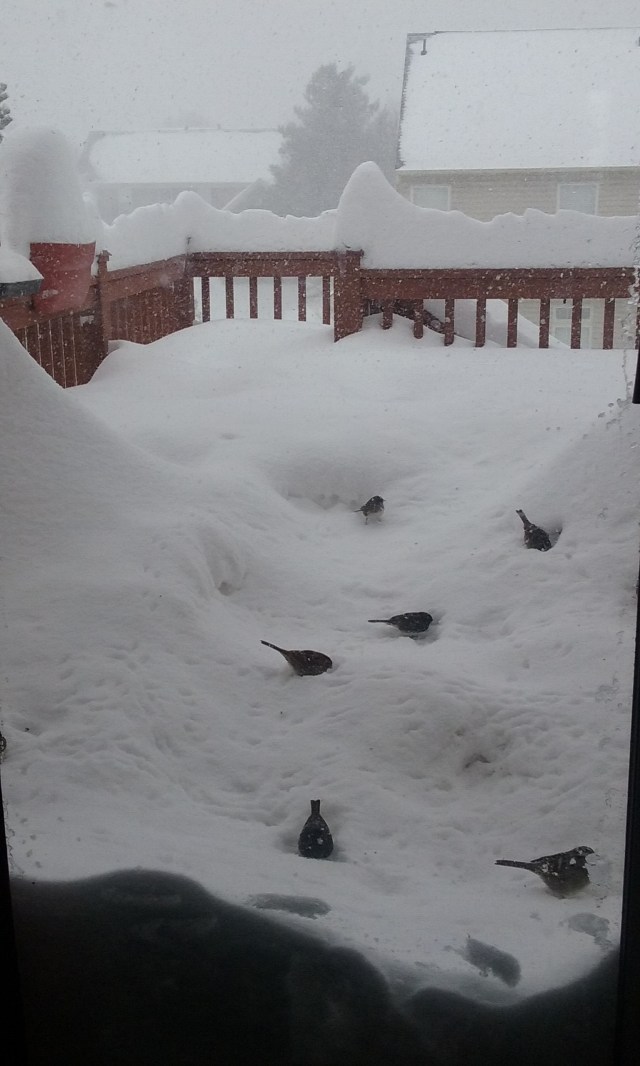
The Thing with Feathers

20160123_110241.jpg
Juncos and friends braving the blizzard of 2016

When I was a little girl and people asked what animal I would like to be, which, for some reason, they did quite often, I would always answer, “A swan.” Likely I was influenced by fairy tale drawings (what was a castle, after all, without a swan swimming in its lake, preferably at sunset?) and at least a little by E.B. White’s The Trumpet of the Swan and Hans Christian Andersen’s The Ugly Duckling. The swan, to me, was the epitome of beauty and elegance, with a potential for a brilliant future, and, of course, it could swim or fly with equal grace.

When I grew a little older, I began to find the swan and bit too ostentatious, and, by the time I was a teenager, desiring total anonymity and feeling very small and frightened, I decided that I would rather be a mouse. Sometime in my thirties, although people had stopped asking, I decided again that I would like to be a bird, but not a swan. Instead, I would like to be a small bird, a common bird, one that is much stronger and and more interesting than people assume.  Maybe a chickadee, like those I watched endure Minnesota winters with cheerful fortitude, fluffed up among pine branches in their small black caps, or a junco, like a little gentleman in a gray tuxedo, so dapper and sprightly, even in the midst of a blizzard. I’m not sure, but I do admire them. And I wish that I could fly.

Because of my affinity for birds, I watch for them, and observe them, and, on a separate page on this blog, record them.  Today was a particularly good day for spotting birds at the Monocacy.  Besides the usual Robins, Red-wings, and Cardinals, I saw an American Goldfinch, an Eastern Bluebird, a few Tree Swallows, a pair of Canada Geese (accompanied, for some reason, by a bachelor Mallard), a Red-tailed Hawk, some noisy Crows, and a wading bird and woodpecker that were just too far away for sure identification.  Honestly, I was so distracted that I left quite a bit of trash on the ground. But, unlike the birds, it’s not going anywhere, and neither am I.  For now.

Let’s Pretend

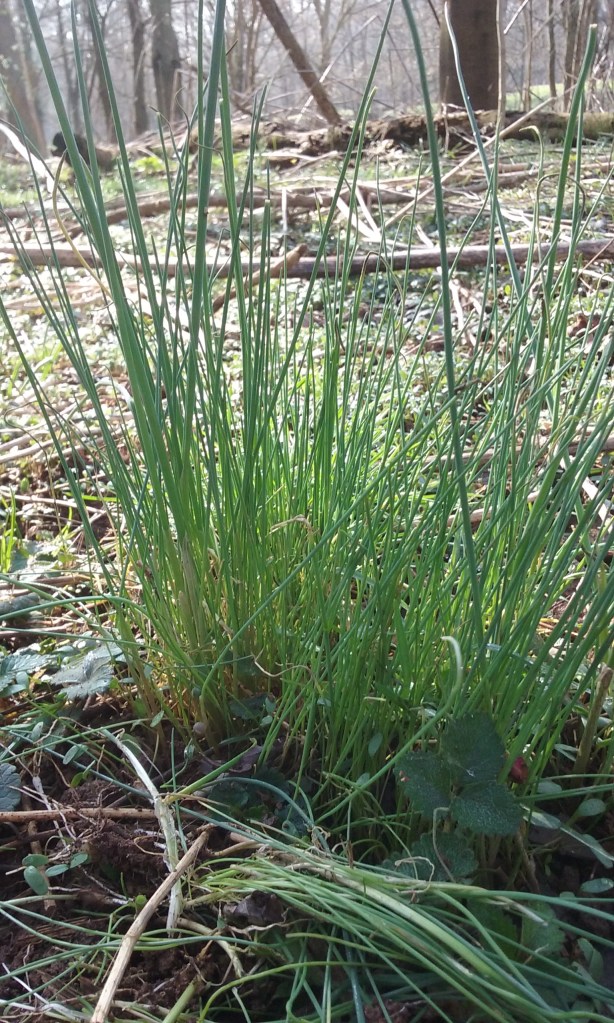
20160316_101443.jpg

Along with wildflowers, early spring brings wild onions, which will continue to flourish through most of the summer. Whenever I see them, I remember an elaborate game my brothers and sisters and I used to play in our backyard. It was called “Shipwreck,” and, more than a game, it was a melodramatic improvisation in which we had to pretend that we’d been stranded on a desert island and needed to find a way to survive. It worked best on sunny summer days, when heat and thirst made method actors of us.

The game was simple. After “crashing” our airplane built of picnic benches and and rusty backyard furniture, we  tumbled onto our lawn, usually into the large patch of dirt we used as home base in our other games. My oldest sister was the organized one, who roused us into realizing our pathetic fate. She ordered us to find shelter, almost inevitably the tunnel formed by the spirea along the fence, and a place to sleep, generally the furniture cushions, which, after baking in the sun, had a warm, comforting mildewy smell. For food, we foraged in our battered lawn, where we could always find some mature wild onions. My sister would collect them and hang them from the bars of our swing set, as if drying them might make them more edible. The game could go on like this infinitely, because, as I recall, we never actually got saved. We just stopped playing.

Thankfully, my sister never actually made us eat the onions.  My younger son, on the other hand, used to eat them all of the time, when his older brother told him that he was Felicia the horse and that wild onions were his proper food. He also ate a lot of grass.  While he doesn’t do this anymore, he still eats a profane amount of vegetables.  We’re making our garden bigger this year.

20160316_101620.jpg

In addition to the onions, I found some lovely marsh-marigolds (caltha palustris), growing by the same temporary pond where I heard the spring peepers a few days ago.  The fresh green leaves and delicate yellow flowers are striking against the dark of the marsh.  Especially now that the shredded red plastic cup is gone.


Still Life in Plastic Bottles

In the 6th grade, in response to my art teacher’s assignment, I drew a series of Sunkist cans in pencil.  I still have these sketches somewhere, probably in a bin of memorabilia in my basement, along with my accumulation of diaries, letters and photo albums.  Today, as I flipped bottle after bottle into my bag, I recalled those Sunkist drawings, and wondered whether I should add to them.  I’ve already got a great retro title: “Soft Drink Still Life: Still Awesome After 30 Years.” There would need to be a little updating, of course, like replacing the Sunkist can with a Vitamin Water bottle.  I got two of those today, in addition to the regular water bottles (mostly store-brand, but there was a large Evian one, too, because litter is a phenomenon that knows no socioeconomic boundaries).  Just in case inspiration strikes, I took a picture of them all before dropping them in the recycling bin.

UPDATE 10/28/16: I found the 6th grade drawings! And then promptly recycled them. This hobby of mine has encouraged me not to accumulate so much…stuff. I did photograph them for posterity, though:

Boats for Mice

It’s been warm and clear the past 2 days, which has allowed the recent floodwaters to recede and the debris left behind to dry in the sun.  As this happens, lots of bundles – leaves, grass and, often, trash, tightly bound by dried mud – appear on the tips of tree branches, like mittens. One boy I know likes to slide the bundles off and let them go down the river.  He imagines them as tiny boats for even tinier mice.