Scraps

Sorting through my photographs, I realized that there are several that I set aside for a particular post but then, for whatever reason, never used. Although it conflicts with my need for some sort of focus for all of my writing, in an effort not to completely lose sight of my intentions for these pictures, I’ve decided to set them all out today, with notes, like a disorganized scrapbook page. (I have tried scrapbooking before, and it just isn’t in me; neither is keeping an immaculate house. Truly I am a failure as a homemaker.) But, of course, having written this paragraph, I’ve assigned a theme.  Why do I do that?

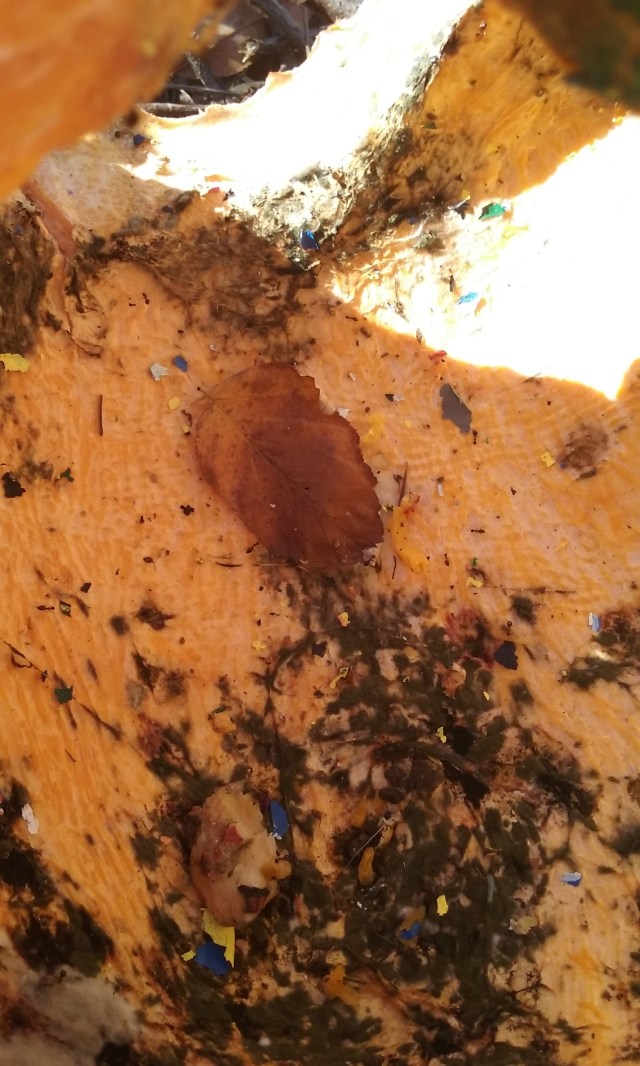
These photographs were to be about line, texture, and symmetry. The old wasp’s nest also reminded me of the huge hornet’s nest that hung inside the ‘Walking Stick’ shrub in my backyard when I was little. I ran right into it during a game of SPUD and suffered the consequences. I never developed a fear of stinging insects, though, perhaps in part because my father took the nest down that winter and allowed my brothers to hang it in their bedroom from the central light fixture. Also, I’m clearly not allergic to them.

20161007_163646.jpg

I found this and spent the rest of the day with R.E.M. songs streaming through my brain.

Peek-a-boo trash: before and after. I nearly missed this Starbucks cup when the only thing visible was the green straw.

And, of course, I’m still running into the problem, months later, with other sorts of trash. (Yes, Bud Light, again).

My mixed-breed, young Rosie, is obsessed with sticking her head in holes. (Mostly made by groundhogs, I think). I’m a little afraid that one day she’ll pop back up with a bite on her nose. My friend’s dog once got bit by a squirrel, and the poor thing bled profusely. The dog was fine, but the car never really recovered from the trip to the vet.

Okay, so now I’m fighting the urge to write a summary paragraph. Mission almost accomplished.
 

A Cold Peace

20170106_104530.jpg

I like snow. While our first fall of the year didn’t amount to much, I made the most of it. My old labrador’s response pretty much sums up my initial excitement:

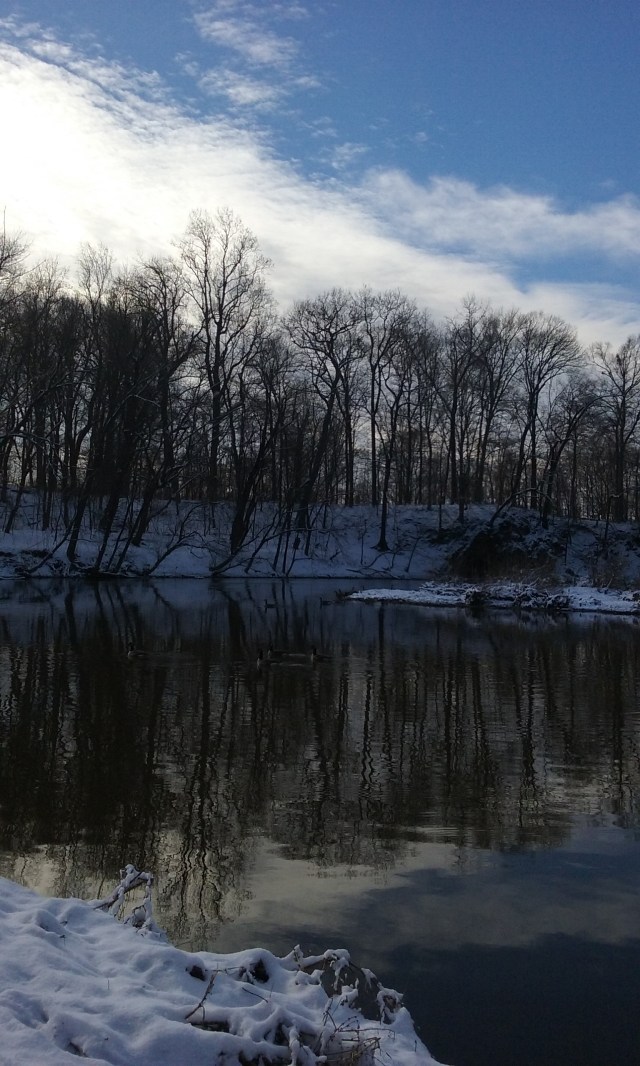
A  little later in the day, after rounding up my fellow explorers, I found a flock of Canada Geese loitering on the river. Usually we see them flying overhead in formation, raucously honking, bringing in the cool blue haze of a winter dusk, but last Friday afternoon they were merely drifting, skirting the light ice along the river’s edge. Eventually a small flotilla ventured over as if to investigate us, which made me wonder whether they were used to living in ponds where people fed them, but when I approached they backed off. (Which is just as well, considering I had one dog on leash who just loves water birds).

20170106_104611.jpg

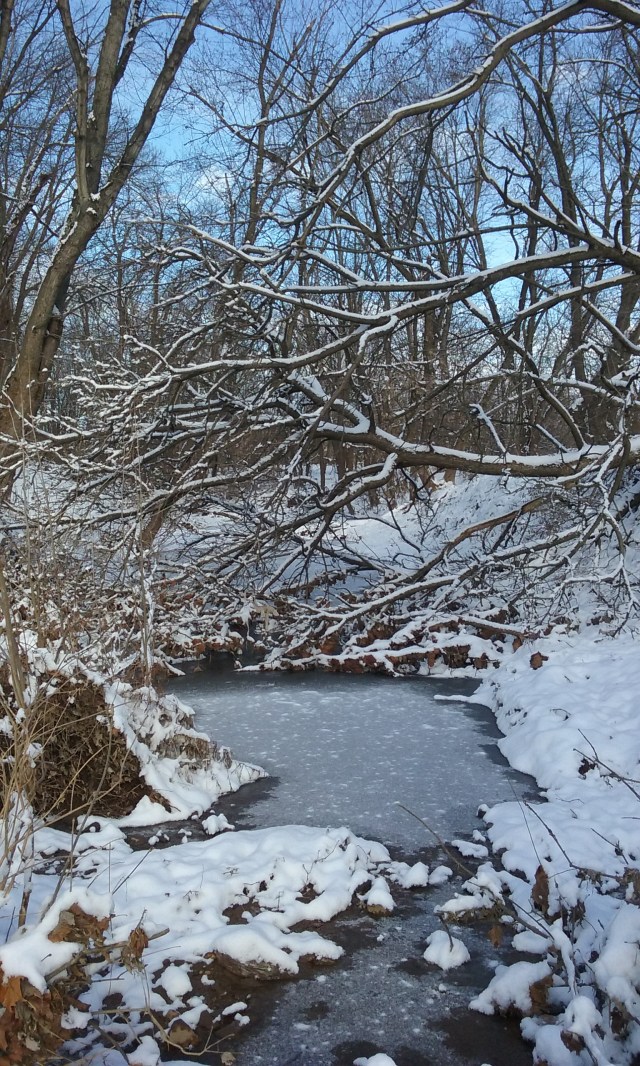
The snow ushered in the stiff, still cold of mid-winter that settles onto me an almost inexplicable peace.As I walk, I smile at the flock of black vultures hunched in a gnarled, bare tree. I quietly watch a herd of six white-tailed deer cross the trail in front of me, leaving behind them a mess of hoof-prints in the snow. I wait for the red-tailed hawk standing sentry over the floodplain to soar from its post. It can be tempting to run from the cold, dashing from car to front door, but it’s so rewarding to hunker down and live in it for a moment.

Predator and Prey

20161123_113312.jpg

As I’ve mentioned before, birds of prey are cool, and particularly noticeable in the winter, when they perch atop the barren branches of leafless trees. Most often I see red-tailed hawks, their voices as sharp and breathtaking as their angular profiles.  Many other predatory birds make their home along the river, some scanning the waters for fish and others prowling the banks for snakes, rodents, and even other birds. So, while I think that they’re cool, there’s a rather large population of living things who most certainly do not.

I rarely see these birds make their kills, but it’s not uncommon for me to find the evidence of them, most often a clutch of feathers and nothing more. They do, however, leave something else behind: the “pellets” of undigested fur and bone that they regurgitate about 10 to 12 hours after their meals. While middle school biology classes seem to dissect only the pellets of owls, all birds of prey produce them, so I’m unsure who produced the one that I found last week, which, on cursory examination with a stick, contained the remains of a shrew.

20161230_145650.jpg

As a caretaker of many rodents – from the trio of mice I kept when I was eleven (Nicholas, Timothy, and Sebastian, because such little gentlemen deserved long and formal names) to our family’s current pair of white rats (the ladies Sugar and Anastasia, themselves temporary caretakers of other rodents; I’m sure that you can guess which one I named) – I have compassion for all of these souls who ended their lives as meals. But I have equal compassion for the birds, who need to eat to survive, feed their young, and go on being the cool creatures that they are.

It’s a difficult balance and heartbreaking at times, but there’s life there, asking to be seen and acknowledged and treasured in all of its terror and delicacy. I can see the void or I can see the life that void has made. Fur, bones, feathers and a beating heart.

Happy new year, from me to you.


Ice on the Monocacy

20161216_162519.jpg

While the winter solstice is a few days away, its spirit arrived last week, when temperatures plummeted and sleet and ice covered the ground in a white and crunchy coating. The winding tendrils of summer’s itchy hop plants have withered and drawn back from the encroaching freeze, revealing bottles, cans, and wrappers formerly hidden by the tenacious invasive’s spreading leaves. As my boys set shards of ice and small stones skidding across the Monocacy’s ice, I gather the debris, not only for the satisfaction of cleaning, but also to keep myself warm. This time of year, I always wonder at the small animals who do without hats and gloves and fleece-lined boots, like the little nuthatches, sparrows, house finches and wrens that play in the brush, or the small group of bluebirds I spotted in the trees. It makes me feel almost ashamed of my eagerness to return home to heat, light, and a big mug of tea.

20161216_161838.jpg


Out of the Fog

20161129_165125.jpg

As yesterday’s rain clouds pushed away, a fog crept in, dampening dusk’s last glimpse of light. We stuck to the path and made our way to Riverside Park, where the Monocacy Boulevard bridge offers some shelter. When we ventured down the boat ramp, we found that the rising waters and runoff had swept along some garbage as well.

20161129_164443.jpg

As I wasn’t wearing my waders, I was confounded in my trash collection. On my return home, however, after I picked up a discarded latex glove, a man who was posting small flags on the floodplain by the bridge emerged from the fog to comment on my work and ask whether I would like to do more for the river. Since I was feeling curious, I asked what he meant, and he revealed that he was from Stream-Link Education  (how uncanny! I just wrote about them in Connections and Clean-Up) and that the group will be gathering volunteers at Riverside Park to plant 300 trees this Saturday, December 3rd, from 9-11 a.m.

This isn’t the sort of message you expect to emerge from the fog at sunset, but I’m a little more practical than a gothic heroine anyway.

A Cold Wind

Winds gusted up to 41 miles per hour over the weekend, ushering in colder weather and, as it turns out, lots of plastic bags.

I used a large one from Pier 1 to gather up all of the others, as well as some wrappers (evidence of Halloween is still out there!) and scattered pages of newspaper. The wind also scattered some more natural debris, like this little nest of grass and cottony seeds:

20161121_100748.jpg

It likely belonged to a mouse or some other small rodent sheltering in the tall grasses just beyond the floodplain. Last week my younger dog managed to stir one out of a hollow log along the sandy banks of the river. Although I didn’t get a very good look before it disappeared, I saw enough to know that it was a long-footed mouse.  There are several species of mice in Maryland (see Maryland’s DNR mammals page for a list). This one, I hope, was able to make a new home for itself (if a hawk didn’t get to it first).

Yesterday, as the winds were calming, I discovered the first ice on the river. It was thin and only very spotty, but still a sign that winter is coming.

20161122_160152.jpg

I like winter, so that is something to be thankful for.

Fun with Fungus

20161115_092651.jpg

I’ve been reluctant to address fungus in this blog, not because I don’t appreciate it but rather because I know so little about it. Classifying it is well beyond my ken. (Although I suppose I could ask my uncle, who just retired from the USDA and for years drove a van with a bumper sticker that read, “Mycology is Mushrooming.” When I say that I think of my uncle when I see fungus, I mean it in only the best way.) Sometimes, though, I just can’t resist making a foray into another field. Because, let’s face it, fungus can be fun.

This week I encountered some puffballs growing on a felled log. They are the funny little fungi that squirt out greenish spores when you touch them. My boys love to squish them and watch the “smoke” disperse into the air, and, honestly, so do I.

After some research, I discovered that these fungi are called Pear-shaped Puffballs, or Lycoperdon pyriforme. I used various resources to confirm my identification, but perhaps the most helpful was the Maryland Biodiversity Project website (see http://marylandbiodiversity.com/viewSpecies.php?species=5036), which is concerned with cataloging all the living things in Maryland. I wouldn’t say that my puffballs were pear-shaped, but I’m not going to get into any body-shaming here. They puffed as well as any other puffball I’ve encountered.

Go have some fun with fungus!

Trash that Mocks

This is one of those days when I have more ideas than I can possibly fit into one coherent post. Do I write about the red-tailed hawk that I knew was there before I saw or heard it because of the quantity and variety of birds that were in a tizzy as I made my way down to the wetlands? Or the man with the Save the Chesapeake license plates who threw a cigarette butt out his window as he drove down Monocacy Boulevard? Or maybe ponder the seasonal nature of trash?

Well, there, I’ve written about all of those things without really writing anything at all. So let’s move on. To pumpkins.

20161111_082914.jpg

About a week ago, I came across this discarded pumpkin at the edge of the woods. Its paint made clear that it was a Halloween leftover, but I assumed that it was a whole pumpkin until I came upon it a few days later, when it looked like this:

20161113_130844.jpg

Someone (or something) had flipped it over to reveal its Jack-o-lantern face, more frightening in its decay, I’m sure, than in its candlelit prime. But, in me, it inspired more questions than fear. Namely: what is it that makes something trash? Is it simply something discarded, or is there some judgement behind the word? If something is trash must it be something that has been devalued or deemed worthless? If we tell someone that their work is trash, typically we are not saying that it has been placed in the garbage but that it is “bad.” Is this a fair judgement on trash?

Can trash be “good”? Well, yes, for instance, some “trash” can be made into something else, like scrap metal into another machine or even a piece of art. But that requires taking the trash out of the trash, transforming it into not-trash, which implies that it was never really trash in the first place. Then, for instance, there is this pumpkin, which, besides its paint, is natural and compostable. It first can feed the wildlife that we can see, like squirrels and these ants:

20161113_130859.jpg

Then it can feed the wildlife that we can’t see, like fungus, bacteria and microbes. It will ultimately break down and return to the earth. So, it is “good” correct?  Discarded but not devalued?

If it is “good” trash, do I leave it? Or does the paint render it less desirable? Or do I move it to a proper composting bin? What is the right thing to do when you run into a painted jack-o-lantern in the forest and no one sees you?

For me, apparently, it is to ask so many questions that I stop making sense.

Four Feet on the Monocacy

20161113_132905.jpg

Yesterday was a good day for sitting by the river. It was warm, and I had my binoculars, lots of trash bags, and only my younger son with me. The older was in the mountains with his father and our younger dog (who, as it turns out, was dodging hunter’s bullets), and, when I took out the leash before our walk, our old labrador had cracked open her eyes, sighed and given me the most rueful expression a dog could muster. I took pity and, with one boy and no dogs, found enough peace to sit down with my binoculars and look for birds.

It’s a time of transition. The noisy red-winged blackbirds have left the marshes, replaced by finches and sparrows and other lesser-seen migrants feasting on the seeds of spent grasses and wildflowers. My favorite juncos have reappeared on my deck, looking for the seed I had kept tossed across it last winter and spring. Just for them (and the cardinals, finches and increasingly vocal squirrels), I resumed the custom last week. Every day now, it feels as if I’m having old friends over at the house.

On the river yesterday, I saw chickadees, nuthatches, juncos, goldfinches, chipping sparrows, house finches, robins, cardinals, crows, a kingfisher and a red-tailed hawk. In other words, nothing new or remarkable enough to be of interest to my younger son, who was contenting himself with styling swords and spears out of branches. Then, just as I was giving up my search (because this is always the way and is so narratively handy), I saw something large moving on the opposite bank of the river. Thinking that it might be a wild turkey, I grabbed my binoculars, only to realize, as it further emerged from the trees, that it was a fox.

20161113_133334.jpg

As it happens, I am uncommonly fond of foxes, a fact for which, I am ashamed to say, Disney must either be blamed or credited. When I was a girl, I fell in love with the animated Robin Hood of Walt Disney, who, as you may remember, was drawn as a handsome, well-spoken, red fox. Likely this early crush was only exacerbated by Wes Anderson’s stop-action adaptation of Roald Dahl’s Fantastic Mr. Fox, which is chock-full of lovely foxes (including the title character, voiced by George Clooney). Of course, they’re beautiful, interesting creatures all on their own (if you’re not raising chickens). Lots of nature photographers and videographers have caught them adeptly diving for mice in the snow or slinking about with their long tails held low and keen eyes high. So, of course, I was overjoyed when I saw this fox prowling along the shores of the Monocacy.

After I satisfied my own hungry eyes, I quietly alerted my younger son, who took the binoculars and held on to them until the fox disappeared into the distance. While he watched, he hushed me when I tried to speak or move and was clearly as mesmerized as I was. Even after the fox was gone, we both just smiled at each other as if we shared some special secret. Or at least I thought so.

Until my son looked at me seriously and said, “Now I’m gonna have the song What Does the Fox Say? stuck in my head the rest of the day.”

Sublimity, meet the Internet.

Choosing Hope

20161107_102053.jpg

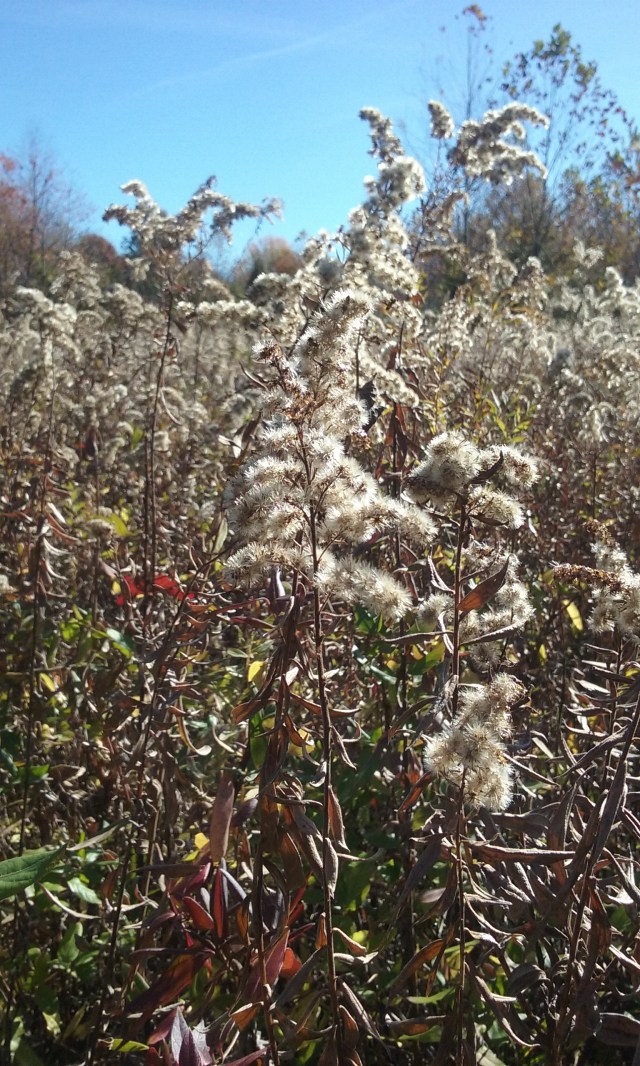
The goldenrod has gone to seed, its cheerful yellow blooms turned to heads of gray. It is as if a gentle frost has covered the fields. Or they have gone into mourning for the coming winter, when even the flowers’ seeds will drop away, and everything will be laid bare. It will look like death, but it won’t be. Winter, no matter how harsh it may appear, is only temporary. And even during winter life teems beneath the frozen earth. Take heart.