Monocacy Milkweed

The milkweed is just beginning to bloom now, both in the open spaces along the river, highways, and farm fields and in my small garden in the backyard. There are many kinds of milkweed, but the sort that I see on my walks is Asclepias syriaca, or Common Milkweed, a dusty plant with broad, green leaves, a vein of magenta, and large, drooping clusters of pale pink, surprisingly intricate flowers. In my garden I grow Asclepias incarnata, a more slender-leaved native commonly known as Swamp Milkweed, and Asclepias tuberosa, a more delicate, orange-flowered variety called Butterfly Weed.

Milkweed is most famous for being the host and primary food source for the larvae of the Monarch butterfly, which has been dwindling in numbers in recent years. While there was a slight uptick in the population overwintering in Mexico the past two years, it’s still threatened primarily by loss of habitat. Planting milkweed and conserving the land on which it grows will help combat a further decrease in the Monarch population.

A few years ago, we managed to host a Monarch caterpillar in our Swamp Milkweed. The rubbery-looking creatures are fascinating and even quite beautiful. Perhaps it’s not a big surprise that they grow to be one of the most identifiable butterflies in the world. Let’s keep it that way.

I Say Crayfish

Growing up, I lived a block away from The Creek, where I played with “the neighborhood kids,” a motley group, ranging in age from four to fourteen, under the dubious supervision of distracted single parents. We played our fair share of Atari and wasted time making fake bids on “The Price Is Right,” but usually we were outside playing a game like Sentry, Capture the Flag, SPUD, Swinging Statues, Truth or Dare, or Spy vs. Spy (which was a big excuse for roaming the neighborhood in two gangs, climbing fences, trampling gardens, and basically being delinquents).  I was one of the youngest and more of a gullible, devoted follower than an instigator, but I always felt included and necessary, despite (or maybe because of?) the occasional teasing and my designated role as the “goody two shoes” of the group. (On a side note: damn you, Adam Ant, for your catchy lyrics!) It occurs to me that this is starting to sound like the foundation of an 80’s Spielberg flick, but, I’m sad to say, we grew up before any miraculous thing happened to save us from ourselves.

The Creek where we played was not an idyllic brook of clean, babbling water winding its way through a peaceful meadow or pristine forest. It was a dirty, shallow stream, funneled under a busy road through massive concrete drain tunnels and hemmed in by apartment buildings that we, with all the smugness of youth, called “the old people apartments.” Besides building dams, getting in water fights, and just generally splashing around, we spent most of our time there catching crayfish. Once or twice we sold them as food to one of the more adventurous parents, but usually we examined and threw them back into the creek or raced them down the hot, gritty slopes of the concrete tunnels.

The Creek, like most small waterways in Frederick, eventually empties into the Monocacy River, where I still catch crayfish with my boys. A few days ago, one of them found a nice young specimen that he eagerly posed for the camera. There are several native species of crayfish in Maryland, and I can’t claim to be able to identify which we have here, but it doesn’t seem to be a Rusty Crayfish, an invasive species that is threatening the survival of the natives. (A very common historical theme. Sigh.) Since we only caught one, we didn’t get to do any racing.  But we have a long summer ahead of us.

Glass and Consequences

20160606_170301.jpg

Glass bottles, in various states of brokenness, litter the banks and waters of the Monocacy River. When they are whole, I pick them up without hesitation to place them in the recycling bin when I get home, but when they’re in pieces, which is far more usual, I undergo an internal debate that goes something like this:

-Hmm, I don’t think I can pick up that piece of glass without cutting my fingers.

-Oh, for God’s sake, of course you can pick it up safely!

-But what about the bag? It’ll cut it open, and then everything else will spill all over the place!

-Just excuses.

-Okay, fine, that bit is big enough to make it worth the risk, but what about that piece? It’s so small that the river will just carry it away and smooth it into nice river glass. Like sea glass. People collect that stuff, don’t they? It’s pretty.

-No, you idiot! If you leave it there, someone –or something- will cut themselves on it!

-But it’s biodegradable…it’ll just turn back into sand!

-Oh, c’mon, you know glass is dangerous: just pick it all up!

-Okay. Sorry.

Yes, it’s true, I have a pretty mean internal voice, but that’s a topic for another time, and, at any rate, it has a point in this situation. Last year, my younger pup cut her paw on an old beer bottle. Not only did she bleed profusely all the way home (and, once we got there, all over the floor), she also managed to cut a tendon that kept one of her toe pads lying flat. Now she walks about with that toe poking up, as if she constantly needs us to wait a moment. It’s awkward, but, according to the vet, painless, and it doesn’t seem to inhibit her curiosity or spastic jump-and-zoom behavior. Still, I’d rather she not cut her foot again, and she adamantly refuses to wear shoes (yes, I’ve tried), so I really need to pick up the glass, despite how pretty it can become after being churned by a river for several years.

Oh, and, also, having better taste in beer doesn’t make you any less of a litterer.

There’s Poison on the Trail

As I walk by the river these days, I am overwhelmed by itchy green things. Poison hemlock plants tower over me on their purple mottled stalks, their delicate white flowers opening like tiny parasols over their broad, finely-cut leaves. They are as poisonous as their name suggests (it’s the extract of this hemlock, conium maculatum, in fact, that likely killed Socrates), which might strike me as ominous if I wasn’t so busy avoiding the Japanese hops spreading their itchy tendrils all over ground. Both of these plants are invasive aliens, crowding out the less rigorous (and, quite literally, less irritating) native plants, like the nodding pale touch-me-nots pictured below. Native or not, I photograph and identify every flower I see on my Wildflowers of the Monocacy page, which I hope will help others who wander the trails by the river.

20160602_172134.jpg

Marquis on the Monocacy

Frederick is full of history, from its Hessian barracks dating to the Revolutionary period, to Francis Scott Key, who wrote the national anthem during the War of 1812, to its Civil War hospitals and battlefields.  Every school child learns about Barbara Fritchie, who, along with Frederick’s “clustered spires,” was made famous by John G. Whittier’s poem about her bold star-spangled flag-waving at Stonewall Jackson when he marched his Confederate troops through town, and it’s hard to miss the multitude of signs and markers commemorating various historical events throughout the county. The Monocacy River is well decorated itself, mostly for its role in the Civil War’s Battle of Monocacy, which “saved” Washington, D.C. by waylaying the Confederacy, but also for another, happier event.

From 1808 to 1942, a stone arch bridge carried the Old National Road (Rte. 40) over the Monocacy River in Frederick, Maryland. On its east end stood a large stone monument shaped like a demijohn, a vessel popularly used for holding bourbon (in fact, there is a rumor that there is an actual demijohn of bourbon inside the monument), which gave the bridge its name, “Jug Bridge.” When the famous Revolutionary War general Marquis de Lafayette came from France to make his popular tour of the United States in 1824, one of his stops was at the Jug Bridge, where he addressed a large crowd of enthusiastic Fredericktonians. After the bridge suddenly collapsed in 1942, the “jug” and a marker commemorating Lafayette’s visit were eventually moved about 2 miles away, to a small park near the Frederick Airport, where the National Road flows into downtown Frederick’s Patrick Street. There have been discussions about moving the monument elsewhere, but I’m glad it’s still not too far from the Monocacy River that inspired it in the first place.

Oh, and it’s quite convenient to the MVA.


*If you like humor in your history and are interested in learning more about the Marquis, I highly recommend Sarah Vowell’s Lafayette in the Somewhat United States. Vowell also reported on Lafayette’s 1824 tour of the United States in This American Life’s Episode 291: “Reunited (And It Feels So Good).” You can find it here:

http://audio.thisamericanlife.org/widget/widget.min.js


The Standing Dead

20160519_164315.jpg

My son has a word for long-dead trees that still stand in the woods: the Standing Dead. The smaller ones he enjoys pushing over, both to test out his muscles and to hear the great crack and groan as they tip and finally fall to the ground. After an ice storm a few years ago, we ventured to the river and found ourselves in dangerous territory. All around us, we heard branches creaking, snapping, and crashing, and the accompanying whump and snap and kersplash as they landed in the forest and the river echoed through the chill, moist air. One such branch missed us by only a few feet. The boys, being heedless daredevils wont to cheer enthusiastically during lightning storms (especially on airplanes) and tornado warnings (which are too few in Maryland, according to them), thought that the whole thing was magnificent, and I had a hard time convincing them that it might be a good idea to go home.

Despite the floods and ice and wind storms that take out these Standing Dead (which, by the way, actually go by the scientific term “snags”), there are still plenty of them along the river.  They are important to the insects, birds and other small animals that use their cavities, dead wood, and solid structure as homes and food sources. Only yesterday, I spied a pileated woodpecker knocking on a snag for insects, and it is always fascinating to peel away the loose bark to find grubs, ants and beetles busily making lives for themselves underneath their surface.

Since explaining to my son the importance of keeping the Standing Dead standing, I have convinced him to leave them alone for the most part.  The large ones, at least, he can’t move anyway, which is fortunate because, whether festooned in vines during the summer, or bent and angled sharply against the sky in winter, these dead trees are really beautiful in their own way.

Trash Collecting Fail

20160513_180738.jpg

My older son is obsessed with watching “Fail” collections on YouTube. He finds them hilarious, but, since they’re really nothing more than compilations of people hurting, maiming, or making idiots of themselves, I can hardly stand them. Then again, I’ve never been a fan of physical comedy; I cringed watching “Mighty Mouse” and “Tom and Jerry,” and the “Home Alone” movies are horrific to me. Besides, the word “fail” is way overused.

Nonetheless, I had my own “fail” on a recent trash collecting mission. While heading home after an uneventful afternoon, I heard my son call my name on the trail behind me. I turned to find him balancing a large round object in one hand and the handlebar of his bike in the other. By the way his shoulder sagged in one direction, I could tell that the round object was heavy, and he was having difficulty maintaining his direction on the muddy trail.

“Look what I found in the water!” my son shouted proudly, “A bowling ball! I actually tripped over it!”

He dropped it on the ground with a thump so that I could examine it, and, after taking a picture, I offered to carry it to the bike trailer for him so that he could ride his bike more easily. After he agreed, I hefted the thing from the ground and propped it against my chest with both arms.  It was heavy, most definitely not the ball of a lightweight bowler, but I’m not a weakling and was unconcerned with making it down the hill to the trailer. Unfortunately, the trail was slicker than I realized, and almost instantly I slipped onto my butt and lost my grip on the ball, which rolled quickly and inevitably back into the river. When we followed it to its entry point, my son looked at me accusingly. The ball had plunged straight into a deep embankment, where it could neither be seen nor reached by the longest stick we could find.

Oops.

I suggested that maybe we would be able to reach it this summer when the water level fell. My son leveled me with an incredulous glance. I admit that, considering the amount of rain we’ve been having, a drought seems far-fetched. But, you know, if the water level fails me, I’ll find another way to, uh, unfail.

Raindrops on Rivers

20160506_162547.jpg

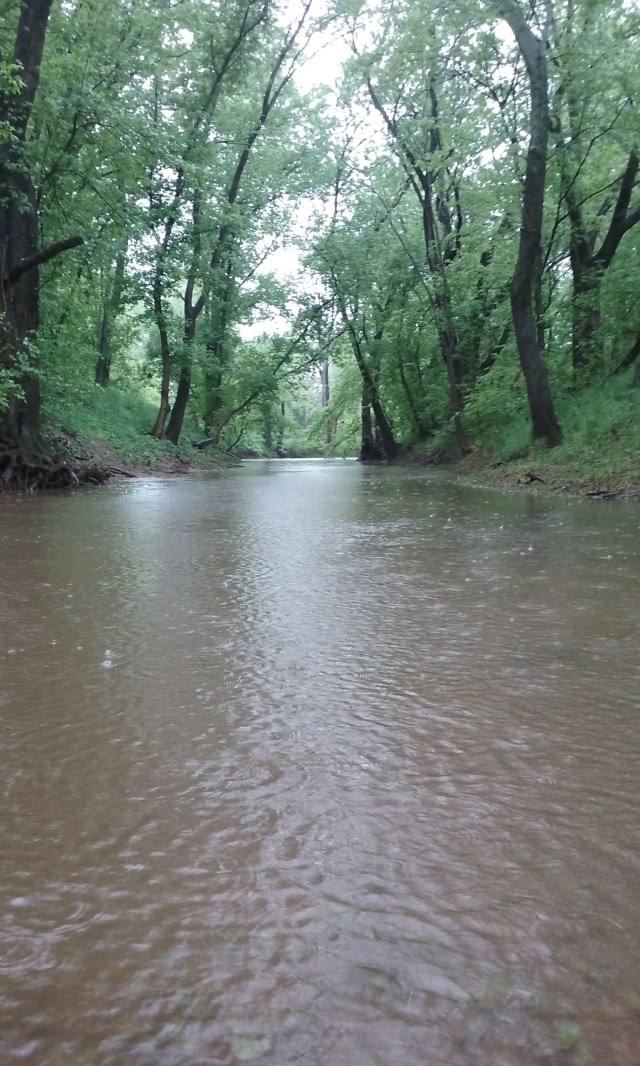
The story is the rain and all of the creatures who have lived in it, despite of it and because of it, for the last two weeks. There are the swallows, skilled aerialists who skim the surface of the water with breathtaking speed, the toads, who hide themselves indifferently beneath the emerging leaves of stinging nettle, the deer, munching dolefully on the flourishing wildflowers and grass, and the squirrels, who never seem to notice the weather.  There are more, of course, including the boys and I and our freezing hands and wet jeans and soggy trash. We are all out there together, on the river, watching the raindrops paint circles on the water.

Washed Away

20160503_171353.jpg

“I guess you haven’t gotten to the river lately,” my son’s doctor said to me this morning.  My younger son, doing his best impression of a weary adult, sighed, rolled his eyes, and replied, “No, we’ve been there every day.” I smiled ands shrugged. “Yep,” I said, “Every day.”

Although I claimed yesterday as a day off, in the end, it wasn’t.  When the boys got home from school, my older son was eager to see how high the water had risen, and, despite some complaining from his younger brother about how we wouldn’t really be able to do anything, we set out with our bikes and bags. We found that the Monocacy had risen high enough to fill even its secondary streams up to their highest banks.  Passage to the island was impossible, our usual dam and bridges submerged 6 feet under rushing, brown water. Newly fallen trees, too, blocked our passage, gathering in their dark limbs the leaves, seeds and small sticks that will become the little mouse boats my son gathers once the water recedes and the sun dries the mud.

Every flood reshapes the river.  I can see why my oldest is so eager to see it after the rain. The “hideout” will be the same in general outline, but so different in particulars. The force of the high waters will undo what he has done, what he has built, and so will offer the chance to do something new.  He sees opportunity, a world wiped clean. His brother, on the other hand, sees the destruction of his efforts, misses what was, and feels discouraged about having to start over again. This conflict of ideas is as constant as the rain lately.

For me, the flood waters will leave behind, on the shores I have so diligently cleaned, trash from miles upstream. There are two ways to look at this: I can be frustrated that I have to start all over again, or I can be pleased that I have new work. Today I choose to be pleased.