Trash from the Past

20160330_171914.jpg

I guess I’ve always had a thing for trash: digging for it, documenting it, and treasuring it. While the blog’s subtitle calls me a “girl,” by now it should be obvious that I’m long past being any such thing, at least in externals. I’m old enough to have accumulated  a number of identities, and one of my favorite ones, one which I thought was never to be picked up again, was archaeologist.  In my twenties, I got an advanced degree in Greek, Latin, and Archaeology and did some digging for a few summers at some classical sites. It’s actually not as exciting a job as most expect.  While I was in the trenches, tourists often asked whether I had found any gold.  I smiled and said, “no,” because I understood that they meant the shiny mineral, but I had found some of my own gold: potsherds, pieces of glass, dirt floors, roads, foundations, and even a tiny marble head. In other words, I had found ancient trash. And, to me, it was fascinating.

The trash I’m finding today could be the treasure of tomorrow.  So should I feel bad about picking it up?  I’ve decided no.  What I find is shreds of plastic, tin cans, agricultural waste, bits of clothing, machine parts, et alia (see, I do know Latin), that has floated down the river.  Its lost its cultural context and, therefore, is of little future value for those who may wish to understand us, say, 1,000 years from now. In other words, there’s no need to give myself a pat on the back for leaving a yogurt container to be buried in the sand.

There are active archeologists (note the different spelling for those who work in North America…wow, I am such a geek today!) working along the Monocacy River.  In fact, there is a large Native American settlement off Biggs Ford Rd. that has been excavated multiple years by the Archeological Society of Maryland.  From approximately 1000-1500 AD, it was occupied by peoples of the Montgomery and Keyser Complex. For more details and pictures from the 2014 expedition, see the link below.

http://marylandarcheology.org/2014_Field_Session_Biggs_Ford.php

Oh, and it’s April, so happy Maryland Archeology Month!


Variation on a Theme: Tires

Tires.  Lots of Tires.  In the water, on land, buried in mud, stuffed with leaves, lacerated, worn, big, heavy, and all dumped at the river.  I have no idea how to deal with them.  If I can dig them out, they’re still too unruly to walk home, especially through a neighborhood with distracted kids. And, even if I do get them home, I have no way to dispose of them. Since Frederick City has no bulk trash pick-up, I either have to hire a dumpster or rent a truck to haul the tires to the dump myself.  Maybe this is why the tires are here in the first place.  Maybe it explains a lot of the trash I find at the Monocacy. Taxes aren’t particularly low in Frederick City, and it seems to me illogical and uninspired not to use some of them for a public service that might well serve the environment as well as the city’s people. So, here’s a message, Frederick: Bring back bulk trash pick-up.

Oh, Baby, Baby (Trees)

20160329_090806.jpg

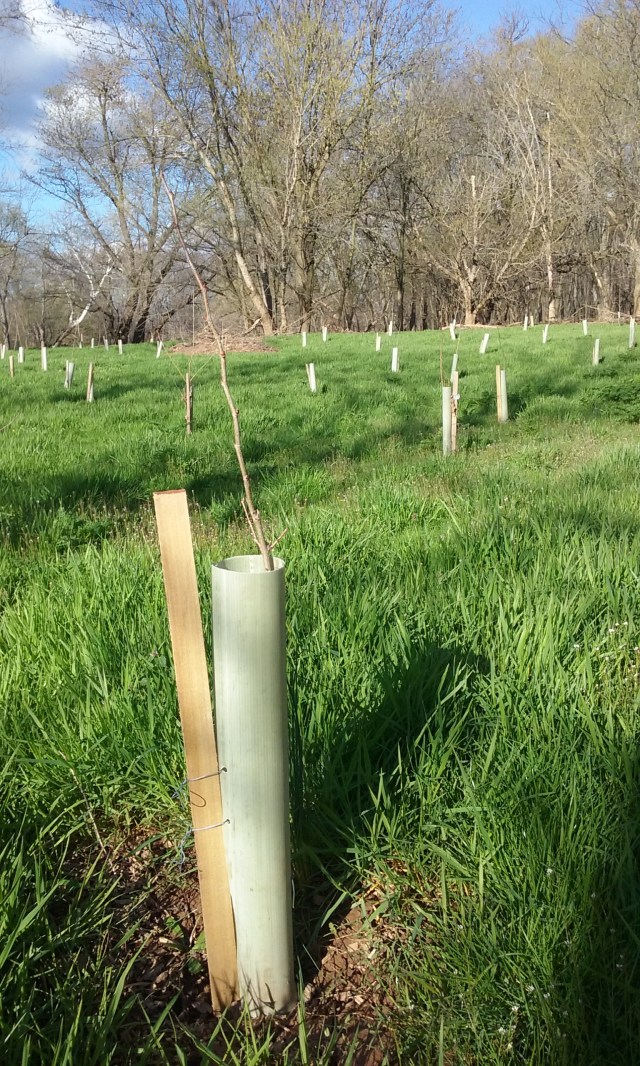
Last summer, an intrepid group planted a number of saplings along a grassy shoreline of the Monocacy River, in an effort, I am sure, to restore the wooded habitat that development had destroyed.  They bolstered these young trees with stakes and corrugated plastic, likely to protect them from foraging White-tailed Deer (of which there is a herd of over twelve that roams my small part of the river), and rabbits (who eat my native shr-, oh, never mind, I’ll start sounding like Elmer Fudd). It’s equally possible, however, that they were hoping to strengthen them against flood waters, which wash over this plain at least two to three times a year. Sadly, I’ve found the corrugated plastic hanging from branches a half mile down the river.  Still, as you can see, there are lots of trees left, and their leaves are just beginning to bud in the March sun.

Weeds are Wildflowers

So, if you don’t treat your lawn, your neighbors will give you the stink-eye, but you’ll also have some lovely wildflowers.  The first of the season are blooming now, while grass is the dingy green of late winter.  Above, on the left, we have Bittercress (cardamine, either Pennsylvania, which is native, or Hairy, which is invasive) and, on the right, Persian Speedwell (veronica persica). You can find a a few paragraphs about these early wildflowers in Bryan MacKay’s A Year Across Maryland: A Week-by-Week Guide to Discovering Nature in the Chesapeake Region (The Johns Hopkins University Press, 2013, pp. 62-63), which is a wonderful book for anyone who likes to tramp around the Old Line State.  While he doesn’t specifically address the Monocacy River, he often discusses the Potomac, which the Monocacy feeds.

Still Life in Plastic Bottles

In the 6th grade, in response to my art teacher’s assignment, I drew a series of Sunkist cans in pencil.  I still have these sketches somewhere, probably in a bin of memorabilia in my basement, along with my accumulation of diaries, letters and photo albums.  Today, as I flipped bottle after bottle into my bag, I recalled those Sunkist drawings, and wondered whether I should add to them.  I’ve already got a great retro title: “Soft Drink Still Life: Still Awesome After 30 Years.” There would need to be a little updating, of course, like replacing the Sunkist can with a Vitamin Water bottle.  I got two of those today, in addition to the regular water bottles (mostly store-brand, but there was a large Evian one, too, because litter is a phenomenon that knows no socioeconomic boundaries).  Just in case inspiration strikes, I took a picture of them all before dropping them in the recycling bin.

UPDATE 10/28/16: I found the 6th grade drawings! And then promptly recycled them. This hobby of mine has encouraged me not to accumulate so much…stuff. I did photograph them for posterity, though:

Hidden Pictures

For convenience’s sake, I use a smartphone to take my pictures, which means that their quality is not very good, and, since my phone is the most basic model, I have no ability whatsoever to take a close-up unless I can get within a few feet of my subject.  This makes nature photography pretty much impossible, particularly if my subject is a skittish deer or a bird perched at the very top of a tree.  Nonetheless, I do try to capture an image every now and then, when I just can’t help myself, like today, when I heard the spring peepers for the very first time.  They’re here somewhere, very loudly trying to find this spring’s hook-up:

20160311_093442

Another loudmouth this time of year is the Red-winged Blackbird, which lords over the same wetland habitat along the Monocacy’s floodplain. I like listening to the Red-wings’ song, ranging from a harsh buzz to a liquidly trill, when they arrive in early March.  When I was a girl, I confused them with Orioles because of their flash of orange. Can you see the one singing at the top of the tree?

20160311_093052

Yeah, I didn’t think so.

Although springtime distracted me today, I did manage to collect a few plastic bottles.  I’ve considered inventorying these by brand or type of drink (water, soda, juice), but, unless someone makes a special request, I’ve decided that this would be rather pointless.  So, for now, I just recycle them.


The Process

Our stretch of warmth has continued, and the evenings are lengthening, which has meant that my walks aren’t so solitary anymore.  I should be glad that we’ve reached the magical 65-degree mark that pulls everyone from their homes, but I’m enough of an introvert (and self-suspected misanthropist) that I’m actually more anxious and annoyed. So, back to the trash.

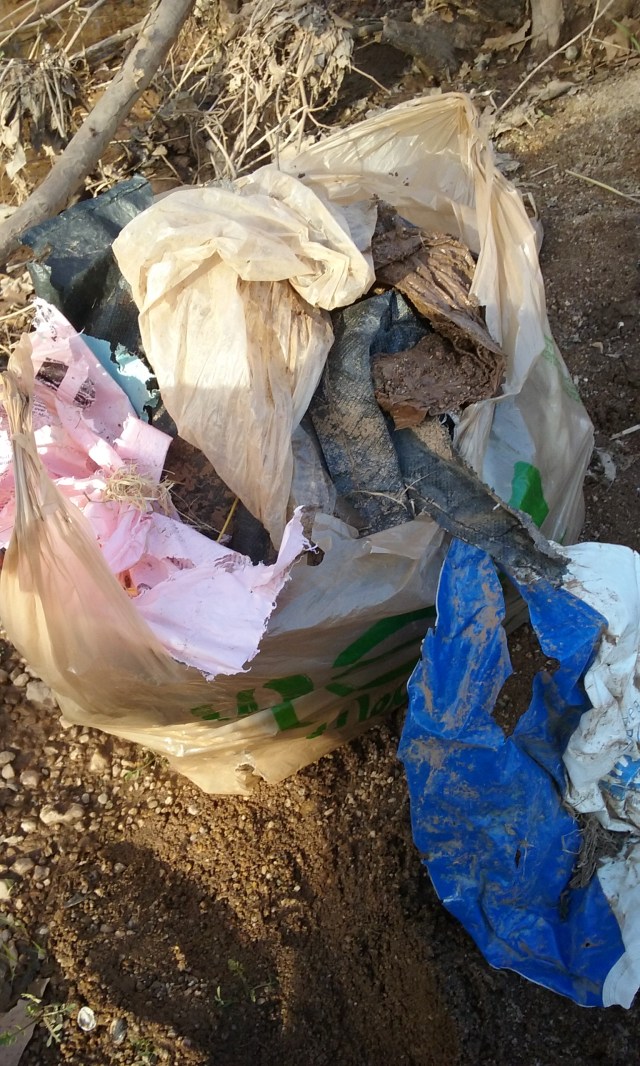
Yesterday, my very first pick-up was large enough to fill my entire trash bag and force me into early retirement.  It’s just as well, because, as you can see in the first photo, the sun was setting by the time I finally wrangled the boys out the door.  There was only time enough to visit what the boys call “the hideout,”which isn’t really very hidden at all.  It’s just off a public trail, but so far below it that it can feel secluded.  The climb down to it becomes more treacherous after each flood, as the water erodes away the soft earth held together only by the roots of imperiled trees.  It is these roots that we must use to reach the hideout, and they make such uneven steps that I daily expect someone to twist an ankle. At the bottom is a stream, separated from the main river by a small “island” of trees.  The stream remains connected to the main river unless there is a drought, but the water flow is never tremendous. Unless there is a flood, I can wade across it in my green rubber boots, which is what I needed to do last night to retrieve my one large piece of garbage.

Under the roots of a decaying tree, half-submerged in the water, was a tangle of sticks, leaves and something else, white and, from what I could tell, plastic. (See the second photo, above). As I approached, I noticed tiny minnows shifting beneath the water, illuminated by the slanting light of the setting sun. My green boots sank in the mud and my movements, stirring up the muck of winter, quickly obscured them. To avoid falling into the slightly deeper water near the white plastic thingy, I used a stick to dislodge it from its nest of leaves and twigs.  It was heavier than I imagined, but I managed to toss it onto the rocky peninsula that extended from the riverbank, where I shook it out to reveal what we see in the third photo, a big old bag of Purina horse feed, weighed down by the gallons of mud it acquired on its trip down the Monocacy River.

After draining it as much as I could, I stuffed it in my trash bag, where it sat drying while I engaged in a few light-saber duels with my youngest.  His stick was less rotten than mine, so he won. I tried to persuade him that he should cheer me up by carrying the trash bag home, but he wasn’t buying that argument.  My arm still hurts.

The Great Blue Heron

20160208_165705

The Great Blue Heron is among the most regular of the birds I see along the Monocacy.  Regular, but not common.  The birds are tall, elegant and brilliantly marked and feathered.   Their size still takes me by surprise, especially when I’ve startled them into flight and they  appear suddenly beside me, strikingly prehistoric looking.  In them, I can see the relationship between birds and dinosaurs.  Just look at these heron footprints I found a few days ago, and for comparison’s sake, imagine your handprints in the mud alongside them.  Those footprints are bigger.

20160208_165506

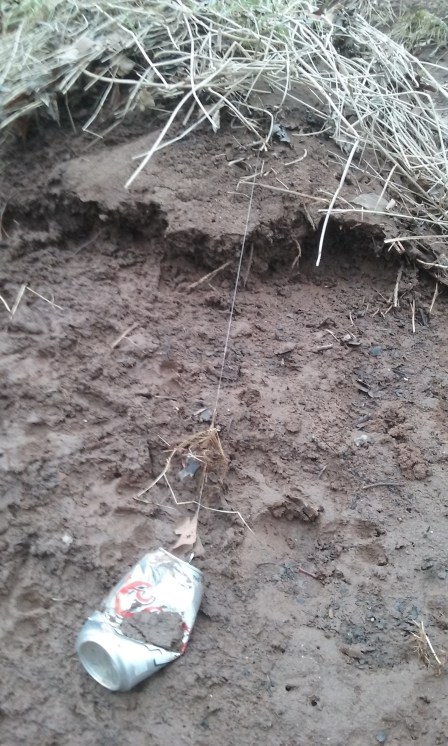
Unfortunately, I’ve encountered one of these fabulous birds caught in fishing line that had gotten tangled in a tree.  It was, understandably, upset and not a little intimidating.  But, fortunately for the bird (and, for me, who would’ve been plagued by guilt), a daring man decided to stop, hazard his own skin, and cut it free. Fishing line (as seen in the photo above, attached to the interior of a beer can) is another thing that I find quite regularly along the Monocacy.  During the summer, the river is a popular destination for fishermen (and women, not that I’ve had any luck, which is another story) to dip their rods in the murky water.  Often they leave behind the styrofoam cups that held their bait and the cans, bottles and wrappers from their picnic lunches. Those bits of trash are annoying, but the fishing line is dangerous.

The good news is that it’s a piece of trash I don’t have to pick up and take home with me.  The city of Frederick has set up little stations to recycle the line at most locations where fishing is a usual pastime. That includes parks along the Monocacy, including Riverside Park under the Monocacy Avenue Bridge, which is the most accessible in the city.


Boats for Mice

It’s been warm and clear the past 2 days, which has allowed the recent floodwaters to recede and the debris left behind to dry in the sun.  As this happens, lots of bundles – leaves, grass and, often, trash, tightly bound by dried mud – appear on the tips of tree branches, like mittens. One boy I know likes to slide the bundles off and let them go down the river.  He imagines them as tiny boats for even tinier mice.

About Trash on the Monocacy

The Monocacy River is my river. I’ve lived along many, including the storied Mississippi, but the Monocacy is my home. A little urban, a little rural, deep in parts, but much too shallow in others, neglected, overused, dumped in (and on), ugly as often as it is beautiful, it is home to thousands – no, billions – of plants, animals, and people. I walk through it every day, pleased in its averageness, finding places for children to play or dog noses to sniff, taking note of the birds and change of seasons, gathering stinking mud on my boots, and I try to make plans and make sense. What have I done right, what have I not done, what should I have done, what will I do, what are my children doing, what will they do, is there anything any of us can do that will make any difference? Always, as I walk, I pass crumpled bottles, dirtied cellophane wrappers, and shredded plastic bags, tangled in trees, half-buried in mud, and hidden beneath dead leaves and grass.  These bits of garbage interrupt me, and, while at first I let them irritate me, I have finally let them answer me.  Now, with my own used bag, I set out to find the trash, ferret out each piece, and actually notice it, acknowledge it, put it in my bag, and leave one small part of the Monocacy a little cleaner, a little more what it should be, a little more itself. My actions aren’t original, of course, and I’m not a particularly spectacular environmentalist (which a smug part of me might hope to be). In fact, I’m more than a little selfish, because I like to see beauty, and that’s why I act.  It’s in so many things.  Even in the trash. And its disappearance.  That’s what this blog is about.  Finding the beauty in the ugliest, most ordinary, most overlooked places and things.  The trash on the Monocacy River.