A Creek with No Name

20160603_174453.jpg

Frederick City lies in a valley, cut through by the Monocacy River and surrounded by the Catoctin Mountains, which are part of the ancient Appalachian Mountains that range through the eastern United States, from Maine to Georgia. When I’m feeling romantic, I tell people that I am from the foothills of the Blue Ridge Mountains, which is another name for this region of the Appalachians. On hazy days, which are plentiful, the mountains do indeed appear blue, a result of the isoprene released by the trees that cover them.

Beside a winding road up to these mountains, runs one of many small streams that flow through Frederick County. Although this stream is small enough to lack a proper name, it is significant in my family as the site of “Uncle J’s property,” which was given to him by my grandfather, who purchased it after proposing to my grandmother along the stream’s banks. Since it cannot be built upon, it is worthless as real estate, and, in fact, no one has ever made an effort to fence in or claim the small plot in any official manner. It’s nothing, really, but a cool escape – quite literally, actually, since it averages about ten degrees cooler than the city proper – where we can splash in the clear water, let the dogs go to roam freely over the fern-covered slopes, and be left entirely alone.


There’s Poison on the Trail

As I walk by the river these days, I am overwhelmed by itchy green things. Poison hemlock plants tower over me on their purple mottled stalks, their delicate white flowers opening like tiny parasols over their broad, finely-cut leaves. They are as poisonous as their name suggests (it’s the extract of this hemlock, conium maculatum, in fact, that likely killed Socrates), which might strike me as ominous if I wasn’t so busy avoiding the Japanese hops spreading their itchy tendrils all over ground. Both of these plants are invasive aliens, crowding out the less rigorous (and, quite literally, less irritating) native plants, like the nodding pale touch-me-nots pictured below. Native or not, I photograph and identify every flower I see on my Wildflowers of the Monocacy page, which I hope will help others who wander the trails by the river.

20160602_172134.jpg

Marquis on the Monocacy

Frederick is full of history, from its Hessian barracks dating to the Revolutionary period, to Francis Scott Key, who wrote the national anthem during the War of 1812, to its Civil War hospitals and battlefields.  Every school child learns about Barbara Fritchie, who, along with Frederick’s “clustered spires,” was made famous by John G. Whittier’s poem about her bold star-spangled flag-waving at Stonewall Jackson when he marched his Confederate troops through town, and it’s hard to miss the multitude of signs and markers commemorating various historical events throughout the county. The Monocacy River is well decorated itself, mostly for its role in the Civil War’s Battle of Monocacy, which “saved” Washington, D.C. by waylaying the Confederacy, but also for another, happier event.

From 1808 to 1942, a stone arch bridge carried the Old National Road (Rte. 40) over the Monocacy River in Frederick, Maryland. On its east end stood a large stone monument shaped like a demijohn, a vessel popularly used for holding bourbon (in fact, there is a rumor that there is an actual demijohn of bourbon inside the monument), which gave the bridge its name, “Jug Bridge.” When the famous Revolutionary War general Marquis de Lafayette came from France to make his popular tour of the United States in 1824, one of his stops was at the Jug Bridge, where he addressed a large crowd of enthusiastic Fredericktonians. After the bridge suddenly collapsed in 1942, the “jug” and a marker commemorating Lafayette’s visit were eventually moved about 2 miles away, to a small park near the Frederick Airport, where the National Road flows into downtown Frederick’s Patrick Street. There have been discussions about moving the monument elsewhere, but I’m glad it’s still not too far from the Monocacy River that inspired it in the first place.

Oh, and it’s quite convenient to the MVA.


*If you like humor in your history and are interested in learning more about the Marquis, I highly recommend Sarah Vowell’s Lafayette in the Somewhat United States. Vowell also reported on Lafayette’s 1824 tour of the United States in This American Life’s Episode 291: “Reunited (And It Feels So Good).” You can find it here:

http://audio.thisamericanlife.org/widget/widget.min.js


Summer of Discontent

20160507_151701.jpg

Every year as summer approaches, I feel my emotions go flat, as if weighed down by the hot and humid mid-Atlantic air that ushers in the season. For years, I couldn’t quite accept the truth of this phenomenon. Summer is supposed to be so wonderful – sun, warmth, longer days, vacation – isn’t it what we’ve been waiting for since January? Depression at a time like this is just ridiculous! Yet, here it is, again, and so insidious in its subtlety: no dramatics, no crying, no morbid poetry; just restless nights, difficulty writing, disinterest in reading, and the usual fear of people.

Why am I writing this? The admission of my depression seems so much more dangerous once it’s recorded. Writing about it is like pulling the stuffing out of a tiny rip in a teddy bear. It emerges as a small ball of innocuous polyester threads and then unfurls, exploding into a cottony mass of shame, judgement and emotions. The bear is left a little emptier, lumpy, slightly misshapen. Maybe the nose is flatter, the right eye askew, the stomach curiously deflated. Even if the stuffing is packed back in, it never looks quite right, or, at least, the way it was before.

But maybe messier is better.

It’s the last day of mental health month, and I’ve been “liking” NAMI’s “stigma free” posts, signing petitions to the U.S. Congress for better mental health care, and sharing articles about mental health awareness all May. It’s much easier to discuss other people’s issues as “other people’s” issues. Nonetheless, their issues are my issues, and, contrary to popular belief, suicide is more prevalent in the spring and summer than it is during the holidays and winter months. Perhaps depression is as well? If this is so, then I am not alone. My issues are “other people’s” issues, too. Who am I, after all, but someone else’s “other people.”

When I named the blog, I never meant for the trash to be taken too literally. Trash isn’t just physical garbage, it’s the flotsam of life in general, sometimes very important to me but worthless to someone else. And, like the trash along the Monocacy, it won’t just go away if it’s ignored. Someone needs to pick it up, look at it, and put it away. If we’re lucky, we might be able to use it again, or turn it into something else, or give it away. And of course we’ll find more of it later. There’s always more. There will be more next year, and the year after that. That’s the way of life.

And so, despite everything, I’ll keep writing.


It’s Not My Party

20160527_091355.jpg

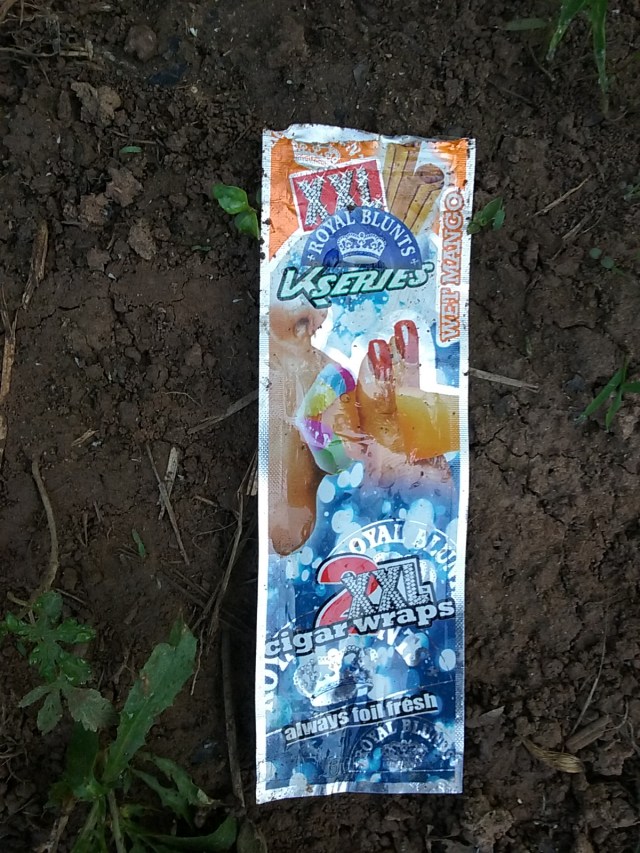
This piece of trash is just wrong on so many levels. First there’s the picture. We all know that’s not a cigar in her mouth. And, if the picture isn’t obvious enough, the words all over the wrapper will give you a hint: XXL, Wet Mango! Besides all of that innuendo (which is much too subtle a word for something that immediately inspires the knowing guffaws of two adolescent boys), there’s the product itself. Mango flavored cigars? I would ask who in the world would ever be tempted by such a combo, if it weren’t obvious by this open wrapper that clearly there is someone out there who thought, “Hey, great idea!” The sort of someone, by the way, who leaves this:

20160527_091207.jpg

In case you can’t tell, that’s the remains of a fire on a well-used trail by the Monocacy River. In addition to cigars, the anonymous fire-starters also consumed Juicy Drop taffy, hot dogs, and Mountain Dew. And, for some reason, instead of using their plastic bags to carry away their trash, they did this:

20160527_091631.jpg

Yep, they burned them. Both of them. Like I said, just wrong.

The Green Stuff

There are wildflowers that aren’t wildflowers.  They’re green or brown or furry or smooth or fringed or winged, in bunches and fronds, clubbed, tall, short, and everywhere. They’re “grass flowers.” I discovered a short article about them by Jennifer Frazer on Scientific American‘s blog “The Artful Amoeba,” which was very good but further persuaded me not to tear my hair out trying to identify grasses as well as flowers and birds. Still, I can’t help but notice the grass flowers now that I know that they’re there, and often they’re weird or dramatic enough to merit a picture. Even the seeds and pods can be interesting. Right now there’s so much green that it’s tempting to overlook all of it, but the most average of green stuff is worth a little bit of time.

The Standing Dead

20160519_164315.jpg

My son has a word for long-dead trees that still stand in the woods: the Standing Dead. The smaller ones he enjoys pushing over, both to test out his muscles and to hear the great crack and groan as they tip and finally fall to the ground. After an ice storm a few years ago, we ventured to the river and found ourselves in dangerous territory. All around us, we heard branches creaking, snapping, and crashing, and the accompanying whump and snap and kersplash as they landed in the forest and the river echoed through the chill, moist air. One such branch missed us by only a few feet. The boys, being heedless daredevils wont to cheer enthusiastically during lightning storms (especially on airplanes) and tornado warnings (which are too few in Maryland, according to them), thought that the whole thing was magnificent, and I had a hard time convincing them that it might be a good idea to go home.

Despite the floods and ice and wind storms that take out these Standing Dead (which, by the way, actually go by the scientific term “snags”), there are still plenty of them along the river.  They are important to the insects, birds and other small animals that use their cavities, dead wood, and solid structure as homes and food sources. Only yesterday, I spied a pileated woodpecker knocking on a snag for insects, and it is always fascinating to peel away the loose bark to find grubs, ants and beetles busily making lives for themselves underneath their surface.

Since explaining to my son the importance of keeping the Standing Dead standing, I have convinced him to leave them alone for the most part.  The large ones, at least, he can’t move anyway, which is fortunate because, whether festooned in vines during the summer, or bent and angled sharply against the sky in winter, these dead trees are really beautiful in their own way.

Trash Collecting Fail

20160513_180738.jpg

My older son is obsessed with watching “Fail” collections on YouTube. He finds them hilarious, but, since they’re really nothing more than compilations of people hurting, maiming, or making idiots of themselves, I can hardly stand them. Then again, I’ve never been a fan of physical comedy; I cringed watching “Mighty Mouse” and “Tom and Jerry,” and the “Home Alone” movies are horrific to me. Besides, the word “fail” is way overused.

Nonetheless, I had my own “fail” on a recent trash collecting mission. While heading home after an uneventful afternoon, I heard my son call my name on the trail behind me. I turned to find him balancing a large round object in one hand and the handlebar of his bike in the other. By the way his shoulder sagged in one direction, I could tell that the round object was heavy, and he was having difficulty maintaining his direction on the muddy trail.

“Look what I found in the water!” my son shouted proudly, “A bowling ball! I actually tripped over it!”

He dropped it on the ground with a thump so that I could examine it, and, after taking a picture, I offered to carry it to the bike trailer for him so that he could ride his bike more easily. After he agreed, I hefted the thing from the ground and propped it against my chest with both arms.  It was heavy, most definitely not the ball of a lightweight bowler, but I’m not a weakling and was unconcerned with making it down the hill to the trailer. Unfortunately, the trail was slicker than I realized, and almost instantly I slipped onto my butt and lost my grip on the ball, which rolled quickly and inevitably back into the river. When we followed it to its entry point, my son looked at me accusingly. The ball had plunged straight into a deep embankment, where it could neither be seen nor reached by the longest stick we could find.

Oops.

I suggested that maybe we would be able to reach it this summer when the water level fell. My son leveled me with an incredulous glance. I admit that, considering the amount of rain we’ve been having, a drought seems far-fetched. But, you know, if the water level fails me, I’ll find another way to, uh, unfail.

In the Other Details

As I mentioned in yesterday’s post, animals can camouflage themselves and render themselves easily missed by my pathetic human eyes, but, as it turns out, so can some trash. A brown plastic bag half-buried in dark earth is barely more visible than a toad amongst leaves, and a faded can of strawberry Fanta covered in long, dead grass hides itself as easily as a moth against the bark of a tree. Other bits of garbage are fortunately more obvious, even if it’s a green Heinekin bottle under long blades of similarly green grass and stinging nettles. I see you, brilliant blue Bud Light label, and you, you bag of ranch-flavored sunflower seeds. (To which I say: is that really necessary?)

I also see the curious looks I get from the more regular trail-walkers when they catch me knee-deep in garlic mustard taking a picture of a beer bottle. With my unkempt hair, old rubber boots, and muddy jeans, I’m certain that I look more bag lady than responsible mother. Once or twice I’ve tucked my phone in my pocket and pretended to be birdwatching just to save my reputation. (Because birdwatchers are such exemplary people? I don’t know.) I guess I should hold my head high and just tell them I’m a trash-collector who writes a blog. I just haven’t gotten there yet.